

When evaluating stocks, investors rely on various financial metrics to determine a company’s intrinsic worth. One such crucial metric is book value. But what exactly is book value, and why is it important for investors? Let’s explore this concept in detail.
What is Book Value?
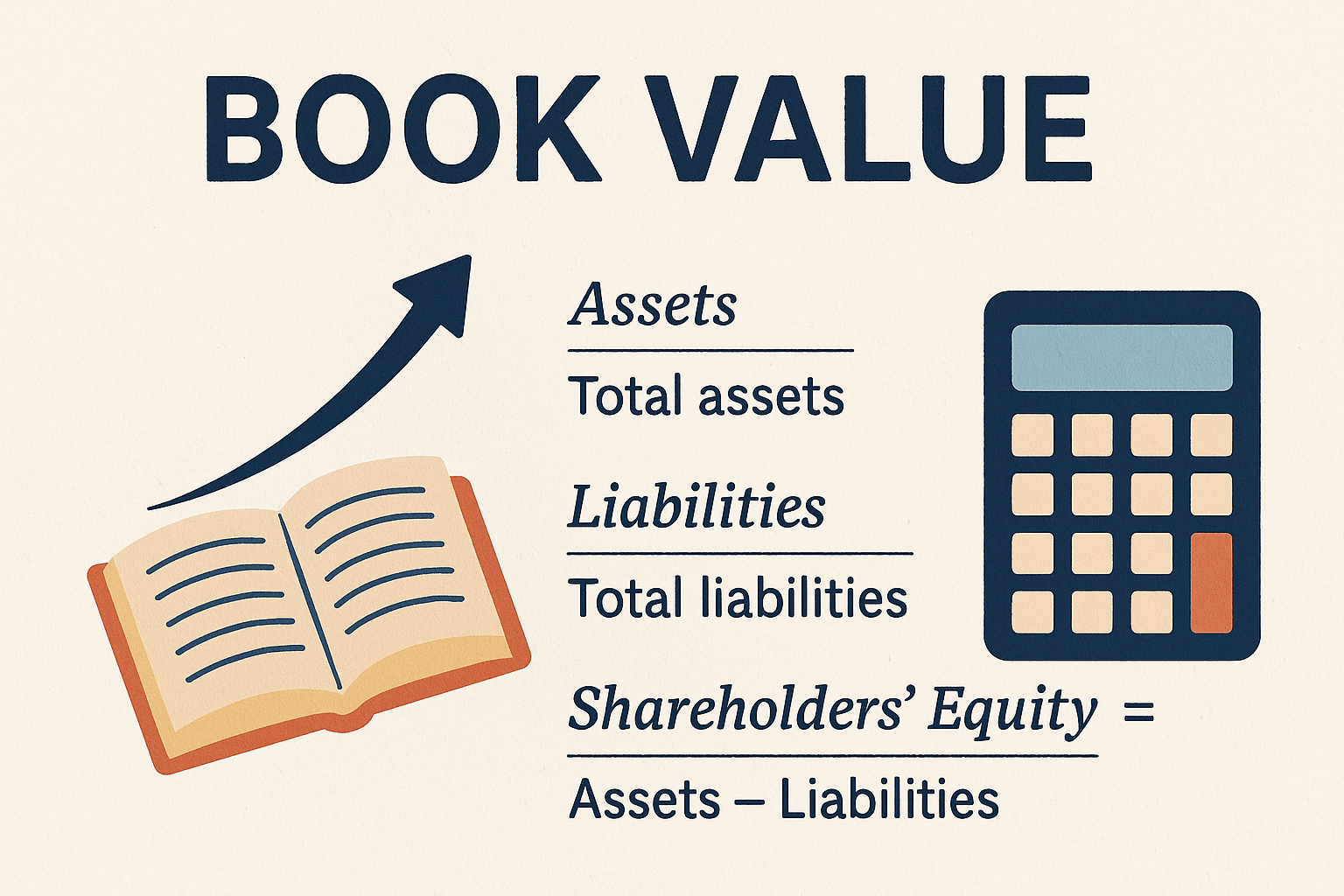
Book value represents a company’s net worth as recorded in its financial statements. It is calculated as:
Essentially, book value reflects what shareholders would receive if a company were liquidated at its recorded asset values.
Why is Book Value Important?
Book value is a fundamental metric for investors because:
- Assessing Undervaluation: If a stock is trading below its book value, it may be undervalued, presenting a potential buying opportunity.
- Financial Stability: A higher book value indicates a strong financial position with more tangible assets than liabilities.
- Comparison Tool: This allows investors to compare companies within the same industry to gauge their financial health.
Book Value vs. Market Value
While book value represents the recorded worth of assets, market value is the price investors are willing to pay for a company’s stock in the open market. Here are some key differences:
- Book Value: Based on historical asset values recorded in financial statements.
- Market Value: Driven by investor sentiment, future growth prospects, and market demand.
- Example: A company with a book value of $1 billion but a market capitalization of $5 billion suggests that investors expect significant future growth.
How to Use Book Value in Stock Analysis
Investors commonly use the Price-to-Book (P/B) ratio to assess stock valuations:
- P/B < 1: The stock might be undervalued, signaling a potential buying opportunity.
- P/B > 1: Investors pay a premium over book value, often due to strong growth prospects.
Limitations of Book Value
Despite its usefulness, book value has some limitations:
- Intangible Assets: It does not account for brand value, goodwill, and intellectual property, which may be significant for companies in technology or service industries.
- Historical Cost: Book value reflects asset values at purchase price, which may differ significantly from current market values.
- Industry Differences: Capital-intensive industries may have higher book values than asset-light companies, making comparisons tricky.
Final Thoughts
Book value is an essential metric for fundamental analysis, helping investors assess a company’s financial health and potential investment opportunities. However, it should be used alongside other financial ratios and qualitative factors for a well-rounded investment decision.
Are you using book value in your investment strategy? Let us know in the comments!

Leave a Reply