

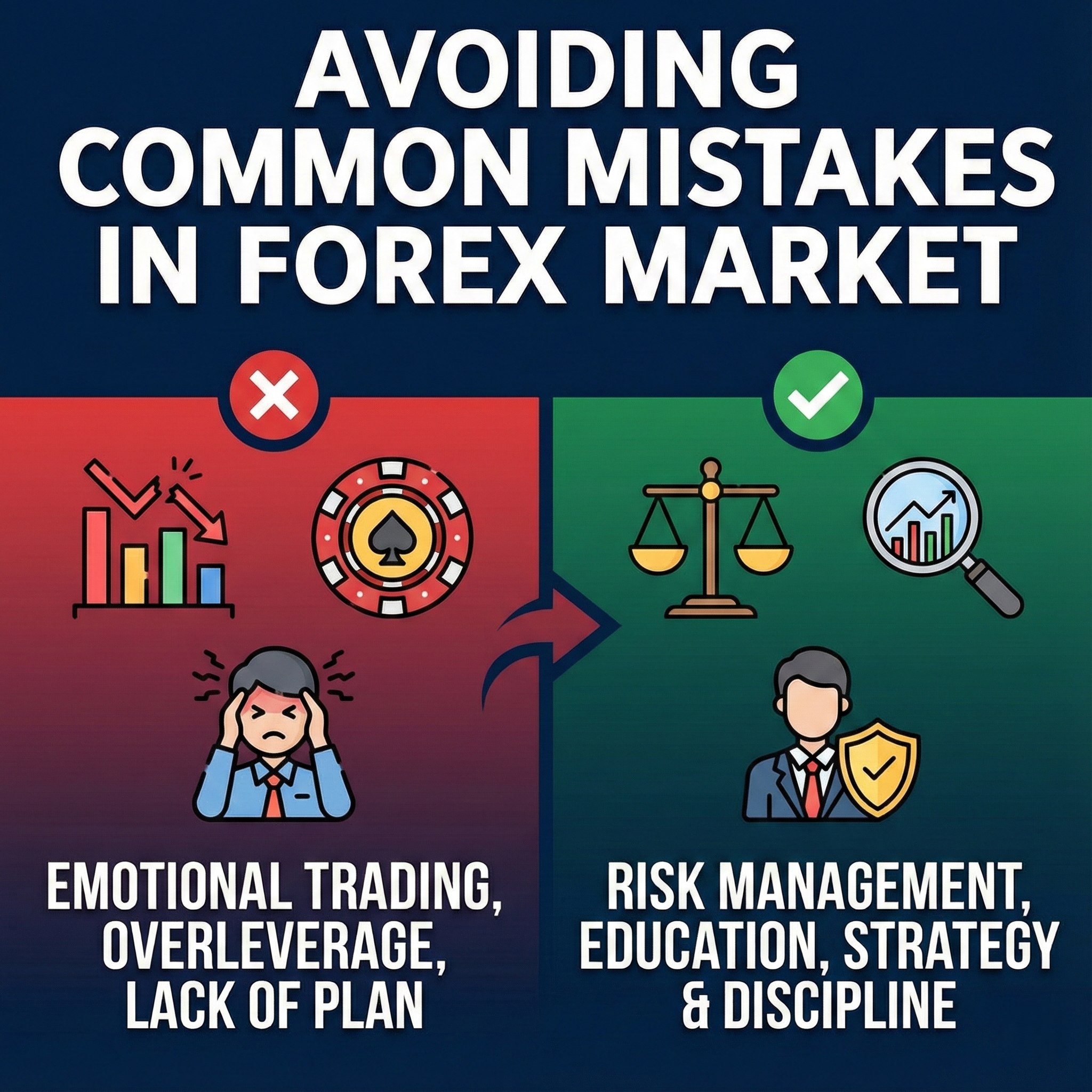
The forex market attracts millions of new traders each year, yet only a small percentage manage to stay profitable in the long run. Although many people blame the market for their losses, the truth is far simpler. Traders lose money because they repeat avoidable mistakes, ignore basic risk principles, rely on emotion instead of structure, and jump into trades without preparation. When you understand why these mistakes happen, you give yourself a real chance to protect your trading success and build long-term consistency.
The Real Reason Most Traders Fail
Many beginners enter the forex market with enthusiasm but little understanding of how it truly works. They see the potential for high returns and immediately imagine fast profits. Because of that excitement, they overlook the important steps required to trade like a professional. As a result, they treat trading like a guessing game instead of a structured process.
Additionally, many new traders bring unrealistic expectations about how quickly they can grow their accounts. When they expect enormous profits, they start taking oversized risks. This mindset pushes them into emotional decision-making, where fear and greed dominate their choices. Although they may have solid strategies, they sabotage themselves by ignoring risk rules, chasing quick gains, or avoiding small losses that eventually grow into damaging ones. As your understanding improves, you realize that preparation, discipline, and emotional control matter far more than any single trade setup.
Why Psychology Plays a Bigger Role Than Technical Skill
Although technical analysis and strategy selection matter, psychology influences results even more. When traders feel pressure to make money quickly, they act impulsively. Moreover, they overlook warning signs that normally would have kept them out of bad trades. This emotional interference causes them to overtrade, increase lot sizes without thinking, and exit trades too early or too late.
Successful traders understand their psychological limits, and they build systems that prevent emotions from taking control. Meanwhile, traders who skip this internal work fall into the same traps repeatedly. Because forex markets move fast, those emotional mistakes compound quickly, and accounts shrink even when strategies are technically sound.
Why Preparation Separates Winners From Quitters
Professional traders treat forex like a business. They study, plan, track performance, and manage risk with intention. In contrast, many beginners skip the learning phase entirely. They enter live markets without a plan, without rules, and without understanding the financial tools they’re using. This lack of preparation guarantees inconsistency.
Moreover, trading without structure leads to random results. Without a written plan, every decision becomes emotional. Without consistent position sizing, every loss feels bigger than it should be. Without proper stop-loss placement, one trade can destroy weeks or months of progress. However, once you identify these pitfalls, you can build a structured trading approach that protects your capital while guiding your decisions with clarity.
Why Recognizing Mistakes Is the First Step Toward Success
You cannot fix what you cannot identify. When traders fail to recognize their own destructive habits, they repeat them. Additionally, they blame the market instead of examining their decisions. Because of this, they never adjust their approach and eventually quit trading altogether.
However, when you study common forex mistakes, you gain insight into your own behavior. You begin noticing patterns, such as taking trades too quickly, moving stop-losses, or getting emotional after a loss. Once you clearly see these tendencies, you can build rules that protect your capital. Although losses will still occur, they remain controlled and manageable.
A New Starting Point for Your Trading Journey
This guide breaks down the most common mistakes traders make and explains why they happen. More importantly, it gives you practical steps to avoid them. With consistent practice, these adjustments transform your trading results. As you build better habits, you trade with confidence instead of panic. Furthermore, your decision-making improves because you rely on structure instead of emotion.
Although the forex market is challenging, it rewards disciplined traders. Once you understand the mistakes that destroy accounts, you can avoid them and position yourself for long-term success. Ultimately, preventing losses becomes more important than chasing every opportunity. Because of that shift in mindset, you build a foundation that protects your capital and supports your growth as a trader.
The Most Common Forex Trading Mistakes and How They Damage Your Results
Most traders don’t fail because of the market. They fail because of repeated habits that gradually drain their accounts. These mistakes appear simple on the surface, yet they cause serious financial and psychological damage over time. Understanding the first set of mistakes helps you avoid the traps that catch nearly every beginner.
Mistake #1: Trading Without a Clear Plan
A large number of traders enter the forex market with no written plan. They rely on instinct, excitement, or a sudden urge to enter a trade. Because they lack rules, their decisions shift constantly. As a result, their entries and exits depend on emotion rather than analysis.
A proper trading plan defines:
- Why you enter a trade
- When you enter it
- Where you take profit
- Where you set your stop-loss
- Which conditions invalidate the setup
Because a plan removes uncertainty, you avoid impulsive choices. Furthermore, it creates consistency. Without it, you’re guessing every time you open a position.
When traders skip planning, they trim winners too early and hold losing trades far too long. This becomes a cycle that slowly erodes the account. Although a trading plan requires effort, it pays off by giving you structure and emotional clarity.
Mistake #2: Ignoring Risk Management Completely
Risk management separates professionals from blown accounts. Yet countless traders focus only on potential profits and ignore the steps required to protect their capital. Because of this, a single bad trade often erases multiple weeks of gains.
Effective risk management includes:
- Always using a stop-loss
- Risking only 1%-2% of your account per trade
- Calculating position size before entering
- Never adjusting risk mid-trade
For example, if you risk 2% on a $10,000 account, your maximum loss should be $200. If your stop-loss is 50 pips away and each pip equals $10, your correct position size becomes:
Position Size = $200 ÷ (50 × $10) = 0.4 lots
Because this formula caps the downside, your account remains stable even during losing streaks.
Traders who ignore risk management often justify it by saying, “This setup is too good- I’ll risk more.” However, overconfidence destroys accounts quickly. Without proper limits, a temporary drawdown becomes a devastating loss. Moreover, failure to use stop-losses creates emotional paralysis, leaving traders trapped in losing positions long after they should have exited.
Mistake #3: Overleveraging and Mismanaging Margin
Leverage attracts beginners because it increases potential profits. However, it magnifies losses just as aggressively. Because of this, overleveraging stands as one of the fastest paths to account destruction.
When you use 50:1 leverage, a tiny price move can wipe out a large portion of your account. For instance, a 2% adverse move on a $500,000 position funded with a $10,000 account eliminates nearly all your equity.
Margin levels matter because brokers use them to determine whether your account is safe. When your margin level reaches 100%, new trades become restricted. If it drops toward 50%, your broker may begin closing positions automatically. Although this protects the broker, it hurts the trader because positions often get closed at terrible prices.
Professional traders limit leverage, maintain wide margin buffers, and reduce position sizes during volatile periods. Moreover, they resist the temptation to use every bit of available leverage. Although it may feel slow, controlled leverage builds long-term survival.
Mistake #4: Chasing the Market After Missing a Move
Chasing occurs when traders enter late because they fear missing out. They see a currency pair moving quickly and jump in without analysis. However, most strong moves lose momentum before they reverse. Because of that, late entries usually create immediate drawdowns.
This mistake creates multiple problems:
- You enter too far from logical support or resistance
- Your stop-loss has to be wide, increasing risk
- Your reward-to-risk ratio becomes poor
- You trade based on emotion instead of setup quality
Professional traders avoid chasing by planning entries in advance. They mark key levels, set alerts, and wait. Although it feels frustrating to watch a move take off without you, entering late causes far more harm than missing the trade. With patience, you learn to accept lost opportunities and wait for the next clean setup.
Mistake #5: Overtrading and Taking Too Many Trades
Overtrading happens when traders take far more trades than necessary. It stems from impatience, boredom, or the desire to make money quickly. Because they keep entering low-quality setups, their accuracy drops and losses pile up.
Consider two traders:
- Trader A takes 5 high-quality trades per day.
- Trader B takes 20 random trades per day.
Trader A remains focused and disciplined. Trader B becomes mentally exhausted and emotional, making more mistakes as the day progresses.
To stop overtrading:
- Set a daily or weekly trade limit
- Trade only setups that match your plan
- Take breaks between trades
- Track your trades to identify patterns
Although taking fewer trades feels counterintuitive, it improves accuracy and protects your capital.
The Most Costly Trading Errors That Destroy Accounts
As traders gain more experience, their mistakes become less obvious but far more dangerous. These next errors often come from psychological pressure, misplaced confidence, or misunderstanding how the market truly behaves. Because they appear logical on the surface, traders fall into them repeatedly. Learning to recognize these traps gives you a significant advantage and protects your trading capital.
Mistake #6: Averaging Down Into Losing Positions
Averaging down happens when traders add more positions after the market moves against them. On paper, it seems smart because it lowers your average entry price. However, the concept quickly becomes destructive when used emotionally.
Here’s the core problem:
If your original analysis was wrong, adding to the losing trade doesn’t make it right. Instead, it multiplies your risk and accelerates your losses.
For example:
You buy EUR/USD at 1.0900 with a risk of $100.
The price falls to 1.0870, and you add another position.
Now your risk has increased, even though the market already signaled that your idea may be wrong.
If the price continues falling to 1.0800, your loss becomes several times larger than your planned risk.
Professionals scale into positions only when it’s planned before entry, and usually only when the trade is moving in their favor. Averaging down, on the other hand, comes from emotional denial and refusal to accept losses. Because losses are part of the game, accepting them quickly is a skill that protects your longevity.
Mistake #7: Disrespecting Stop-Loss Orders
Stop losses exist to protect your account, yet many traders treat them as optional. They move them farther away when the market turns, or they remove them entirely. This usually happens because they believe the market will return and “save” them.
However, the market rarely cooperates with hope.
Moving a stop-loss after entering a trade increases your risk without improving your position. Once you shift your stop out of fear, you break your trading rules. Moreover, this behavior encourages future violations, increasing the chances of catastrophic losses.
A stop-loss should never be adjusted to create more risk. You can tighten it as the trade becomes profitable, but pushing it farther away undermines your entire trading plan.
reat your stop-loss as a contract with yourself. You set it based on analysis, not emotion. Respecting that decision prevents one trade from destroying weeks of progress.
Mistake #8: Ignoring Economic News and Fundamental Events
Technical charts reveal patterns, but major price movements often come from fundamental news. Ignoring the economic calendar creates unnecessary risk. When traders hold trades during high-impact events- like interest rate decisions or employment reports- they expose themselves to extreme volatility, wide spreads, and unpredictable gaps.
For example:
During a major announcement, spreads can widen from 1 pip to 20 pips instantly. Additionally, price can jump over your stop-loss entirely, triggering a slippage-filled exit far worse than expected.
Traders who ignore fundamentals often wonder why their perfectly good technical setup suddenly failed. However, the market reacts to information, not just patterns.
Professionals stay aware of scheduled announcements. They either close positions before the news, reduce their exposure, or adjust their strategy to account for volatility. This awareness protects them from unnecessary and sudden losses.
Mistake #9: Emotional Trading and Revenge Behavior
Emotions influence traders more than they realize. After a loss, fear pushes traders to avoid valid setups. Meanwhile, after a big win, greed encourages oversized positions. However, the most dangerous emotional mistake is revenge trading.
Revenge trading happens when you try to recover losses quickly. Instead of following your plan, you rush into trades without analysis. Because you focus on getting the money back, not making a good decision, your accuracy collapses.
Emotional trading leads to:
- Overtrading
- Oversized positions
- Ignoring stop-losses
- Chasing the market
- Entering without signals
The best traders follow rules, not emotions. They stop trading when they feel angry or impatient. Additionally, they take breaks after major losses to reset mentally. Because discipline controls your results more than strategy, mastering your emotions becomes an essential skill.
Mistake #10: Trading Without Proper Education
Forex trading looks simple from the outside. New traders think they only need to predict price direction. Because of that misconception, they underestimate the depth of knowledge required to succeed.
In reality, forex trading requires understanding:
- How central banks influence currencies
- How market sentiment shifts
- How volatility changes behavior
- How leverage and margin work
- How to read technical and fundamental signals
Many traders skip the learning phase and rush into live trading. As a result, they use real money to pay for mistakes they could have avoided with proper study.
Professionals invest time in education before risking meaningful capital. They study strategies, practice in demo accounts, analyze past trades, and refine their approach. Although learning takes effort, it prevents costly errors.
Advanced Trading Mistakes That Quietly Damage Even Experienced Traders
As traders gain more screen time, their mistakes become more subtle. These errors don’t always cause immediate blow-ups, but they drain accounts slowly and undermine progress. When you understand these advanced mistakes, you prevent hidden weaknesses from sabotaging your long-term growth.
Mistake #11: Choosing the Wrong Broker or Platform
Your broker is your gateway to the forex market. When traders choose a poorly regulated broker or a platform with weak execution, they face unnecessary risks. Although spreads and commissions matter, execution quality and fund safety matter even more.
Problems with the wrong broker include:
- Slow executions
- Excessive slippage
- Spread manipulation
- Weak customer support
- Poor fund protection
A difference of only 1-2 pips in slippage may seem small, but across dozens of trades each month, it becomes significant. Additionally, brokers without proper regulation may not keep client funds separate from operational funds, creating financial risk.
To avoid this mistake:
- Choose a well-regulated broker
- Confirm that funds are held in segregated accounts
- Compare real-time spreads, not advertised ones
- Test execution speed with a small live deposit
Because your broker directly affects every trade, selecting the right one protects both your capital and your strategy.
Mistake #12: Setting Unrealistic Profit Expectations
Unrealistic expectations lead traders into dangerous decisions. Many beginners dream of doubling their accounts quickly or achieving 50-100% returns every month. Although these fantasies sound exciting, they push traders into excessive risk-taking.
When expectations become unrealistic:
- Position sizes inflate
- Leverage becomes uncontrolled
- Impulsive trades increase
- Pressure builds after losses
- Emotional instability grows
Consistent traders think differently. They aim for steady growth, not rapid jumps. They understand that professional hedge funds consider 10-20% annual returns impressive. Meanwhile, retail traders often destroy their accounts chasing returns that sound impressive on social media but have no real foundation.
Because trading relies on compounded growth, modest and steady returns become powerful over time. With patience, consistency outperforms aggressive, high-risk behavior.
Mistake #13: Moving Your Stop-Loss After Entering a Trade
Few habits ruin accounts faster than moving a stop-loss to create more room for a losing trade. Traders convince themselves that “the market just needs a little more space,” but the truth is simpler. Moving a stop after entry represents emotional attachment and fear of loss.
Three things happen when you move your stop:
- You break your own rules.
- You increase your risk without new analysis.
- You encourage future rule-breaking.
When your stop-loss is placed based on chart structure, it already sits at the point where your trade idea becomes invalid. Moving it means ignoring your own logic. Additionally, once you start shifting stops, you stop treating risk limits seriously.
Although it feels uncomfortable to accept a loss, protecting your account matters far more than trying to save one trade. Losing small is part of winning big later.
Mistake #14: Ignoring Currency Correlations
Many traders believe they’re diversifying by trading multiple pairs at once. However, they overlook how currency pairs correlate with each other. As a result, they unintentionally load their account with multiple trades that all move in the same direction.
For example:
- EUR/USD and GBP/USD usually move together.
- EUR/USD and USD/CHF often move in opposite directions.
If you go long EUR/USD and long GBP/USD, you are essentially doubling your exposure to European sentiment. A negative economic release from the Eurozone could hit both trades at once.
By understanding correlations, you avoid:
- Overexposure
- False diversification
- Larger-than-expected drawdowns
You also gain the ability to hedge or offset trades intentionally. Because correlations shift over time, reviewing them regularly strengthens your trading decisions.
Mistake #15: Skipping the Trading Journal
A journal transforms random trading activity into structured improvement. Many traders skip it because it feels tedious. However, skipping it removes one of the most powerful tools for long-term growth.
A proper journal records:
- The setup
- Your entry and exit
- Stop-loss and take-profit levels
- Market conditions
- The reason for taking the trade
- Your emotional state
- The final outcome
When you review the journal weekly or monthly, patterns emerge. You might notice that certain market conditions consistently lead to bad trades. You may see that you exit winners too early or hold losers for too long. These insights don’t appear without documentation.
Although journaling takes time, it saves money. Because you learn from your history, you avoid repeating expensive mistakes.
Mistake #16: Trading in Unfavorable Market Conditions
Not every market condition suits your strategy. Some strategies thrive in trends, while others do well in ranging markets. When traders apply the wrong strategy in the wrong environment, losses appear quickly and repeatedly.
For example:
- Trend-following systems fail inside consolidation zones.
- Counter-trend strategies fail during strong directional moves.
When traders do not adapt, they experience unnecessary drawdowns. Instead of forcing trades, professionals analyze conditions first. If the environment doesn’t support their strategy, they wait. Although sitting out feels uncomfortable, it prevents low-quality trades.
Additionally, experienced traders avoid trading during extremely choppy markets, thin liquidity periods, or unpredictable event windows. With patience, they allow the market to form cleaner structures before re-entering.
Building a Defensive Trading Framework and Strengthening Long-Term Success
Once you understand the most common forex mistakes, you can begin designing a personal system that protects your capital and guides your decisions. A defensive framework keeps you consistent, reduces emotional trading, and helps you adapt to changing market conditions. Although no system eliminates losses, a strong structure prevents small errors from turning into devastating setbacks.
1. Building Your Defensive Trading Framework
A defensive trading framework acts like the foundation of your business. It defines how you manage risk, how you find trades, and how you evaluate your performance. Without a structured system, your results become random. With one in place, you gain clarity and discipline.
A. Create a Detailed Written Trading Plan
Your plan should include:
- The market conditions you prefer
- The technical or fundamental signals you use
- The exact criteria for entering trades
- Your standard stop-loss and take-profit rules
- Your risk percentage per trade
- Your preferred trading times
- Your rules for sitting out undesirable conditions
Writing these rules down increases your accountability. Because the plan becomes your guide, you avoid relying on emotional impulses.
B. Set Strict Risk Parameters
A strong risk model protects your account even during losing streaks.
Include rules such as:
- Maximum 1-2% risk per trade
- A fixed position sizing formula
- Mandatory stop-loss on every position
- A minimum risk-to-reward ratio for all setups
These rules keep your downside limited, giving your strategy room to grow.
C. Establish a Daily Loss Limit
A daily loss limit prevents emotional spirals. For instance, you can decide to stop trading if you lose 3% of your account in a single day. Because this lock-in stops the emotional momentum that leads to revenge trading, it protects your capital from impulsive decisions.
D. Decide When Not to Trade
Your system should specify situations when you stay out:
- Right before high-impact news
- During extremely low-liquidity sessions
- When spreads widen unexpectedly
- When your emotions feel unstable
- When market conditions conflict with your strategy
Knowing when to avoid the market is just as important as knowing when to enter.
2. Personalized Rules to Counter Your Weaknesses
Every trader has specific weaknesses that lead to repeated mistakes. Your defensive system should directly address them.
If you overtrade:
Set a maximum number of trades per day.
If you chase the market:
Enter only when your full checklist is met.
If you struggle with impatience:
Use alert systems to notify you when the price reaches your entry zone.
If you have trouble accepting losses:
Review your risk percentage and lower it temporarily.
If emotional trading harms you:
Take a mandatory break after any significant loss.
Your rules should reflect your personal tendencies. Because these tailored boundaries support discipline, they protect you from your own worst habits.
3. The Power of Documentation and Continuous Review
Documenting your trades gives you an advantage over traders who rely solely on memory. A detailed journal becomes a mirror that shows your strengths and weaknesses with clarity.
A. What to Record
Your journal should include:
- Why you entered the trade
- Where you placed your stop-loss
- Whether you followed your plan
- The emotional state you felt
- What happened after the exit
- What you learned
The goal isn’t to create a perfect journal. The goal is to create one that helps you grow.
B. Reviewing Your Results
Review your journal once a week or once a month. Look for:
- Patterns in your losing trades
- Conditions where you perform best
- Times of day that suit your style
- Emotional behaviors that affect results
- Frequent rule violations
Once these patterns become clear, you refine your rules and improve your system.
Because this habit compounds over time, your trading becomes sharper and more consistent.
4. Why Avoiding Mistakes Matters More Than Finding the Perfect Strategy
Many traders spend years searching for a flawless system, yet they ignore the mistakes that destroy their accounts. Ironically, eliminating harmful behaviors improves your profitability far faster than finding a new indicator.
Here’s why:
- Small mistakes accumulate quickly
- Big mistakes can erase months of progress
- Emotional reactions grow after errors
- A perfect strategy becomes useless without discipline
Preventing common mistakes builds stability. Once your foundation is secure, you can scale your strategy with confidence.
5. Your Long-Term Path to Consistent Success
Although the statistic that “95% of traders fail” sounds intimidating, it becomes far less alarming when you understand why those failures occur. Most traders ignore risk, skip planning, chase the market, overleverage, and trade emotionally. These mistakes are avoidable when you follow structured rules.
Becoming a successful trader requires more patience than talent. Moreover, consistency matters far more than intensity. When you trust your process, control your risk, document your decisions, and prevent emotional behavior, your performance improves naturally.
A Sustainable Trader Focuses on:
- Protecting capital before chasing profits
- Following a tested plan rather than impulse
- Managing emotions instead of reacting to them
- Making gradual, steady improvements
- Viewing trading as a long-term business
- Allowing compound growth to work over time
These habits place you in the small percentage of traders who build durable success.
Conclusion: Your Advantage Begins With Discipline
You now understand the core mistakes that destroy most forex accounts. Once you recognize them, you gain the power to avoid them. The market rewards traders who respect risk, follow sound rules, and treat trading as a discipline rather than a gamble.
Although losses will always occur, your goal is to keep them controlled and manageable. Each mistake you eliminate strengthens your foundation. Each rule you enforce builds confidence. Each improvement compounds over time.
When you commit to disciplined execution, you create a path toward consistent profitability. Instead of hoping for good trades, you prepare for them. Instead of reacting emotionally, you act with intention. With patience and structure, you shift from surviving the market to thriving in it.

Leave a Reply