

Understanding Trends, Ranges, and Why Strategy Matching Matters
Most forex traders don’t struggle because they misread every chart. They struggle because they use the right idea at the wrong time. When the market trends, range tactics fall apart. When the market drifts sideways, trend systems lose their edge. This mismatch drains accounts slowly, and yet it’s one of the easiest trading problems to fix once you learn how to read the conditions. As you work through this guide, picture your favorite currency pair and think about how often it behaves like the examples here.
You’ll notice that spotting a trend or a range doesn’t require advanced software. Clear eyes, simple tools and a structured checklist can help you understand what the chart is doing. Once you know the environment, you can pick the strategy that fits. Because of that, learning this skill can change your entire trading experience.
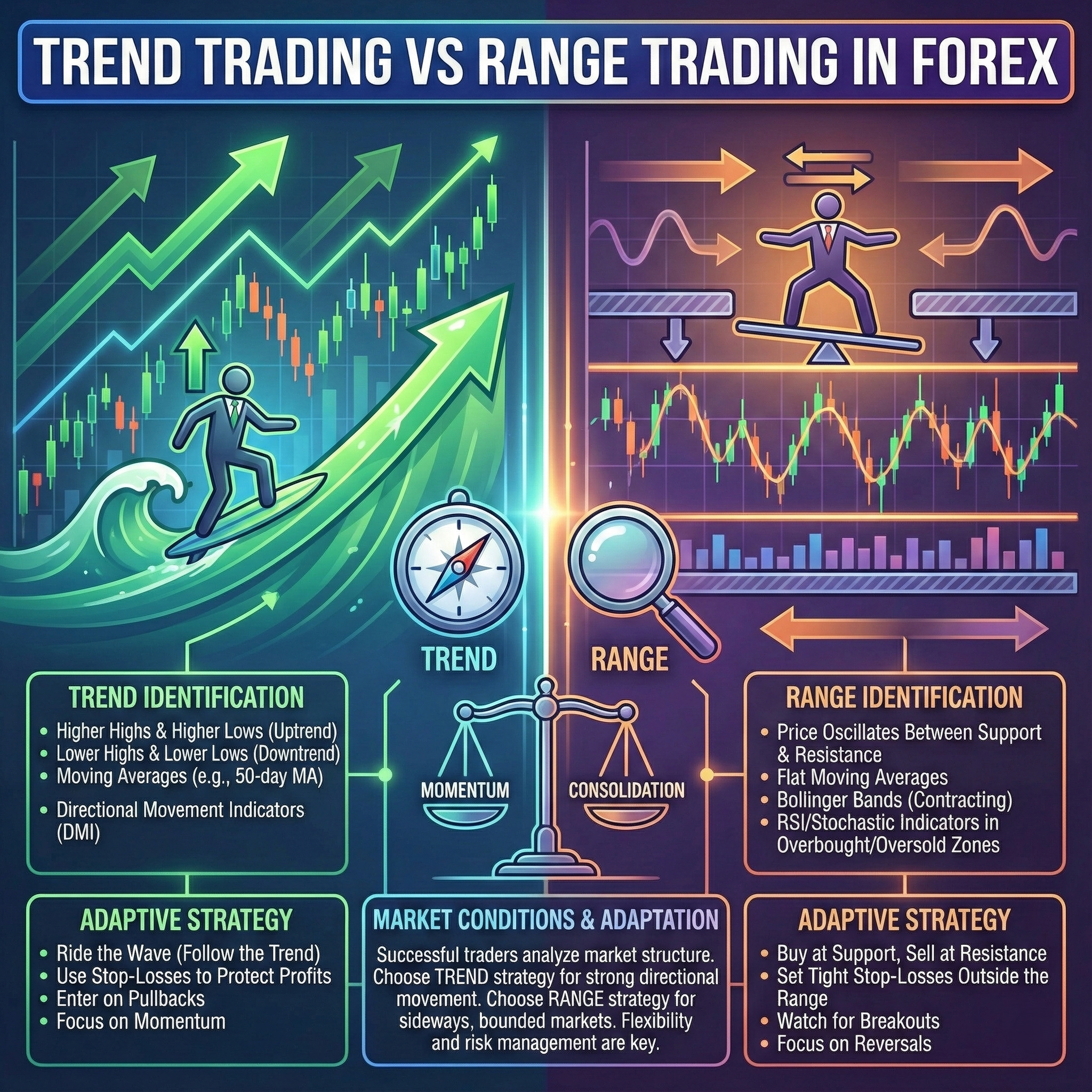
A trending market moves with a clear sense of direction. Price doesn’t wander aimlessly. It pushes upward through a series of higher highs and higher lows, or it sinks through lower highs and lower lows. These patterns show you where buyers or sellers have taken control. When the steps line up cleanly on the chart, the direction becomes obvious. Moreover, the slope of the move often creates a strong visual cue even before you draw a line.
In an uptrend, candles often cluster above a moving average because buyers keep supporting price on small dips. In a downtrend, candles stay beneath that same line as sellers press the market lower. When you see this kind of behavior, trend trading feels natural because the market rewards you for moving with the larger push instead of fighting it.
A ranging market looks the opposite. Instead of climbing or falling, price bounces between a ceiling and a floor. The highs form a clear resistance zone, and the lows create a support zone. Although price keeps moving, it doesn’t commit to one side. It travels in a sideways rhythm that builds a box on your chart. In these moments, trend tools stop helping, yet range tools start shining because the market behaves predictably at the edges.
Many traders ignore this simple difference. They try to use a breakout method inside a narrow box, or they attempt to buy dips inside a messy sideways move. These choices create frustration because the environment doesn’t support the tactic. However, once you understand the structure, switching your approach becomes easy.
Traders who survive long term adapt naturally. They check the market type before looking for entries. They don’t force patterns. As a result, they avoid many unnecessary losses. You can build the same habit with a little practice and a clear checklist.
Why Matching Strategy to Market Type Matters
Trading isn’t only about patterns or indicators. It’s about context. A trend strategy assumes the market will continue moving in one direction. A range strategy assumes the market will stay inside a defined box. When you mix the two conditions, your results suffer even if your rules are solid.
Although this sounds simple, many beginners fall into the trap of using one setup everywhere. They learn a trend breakout pattern and apply it to every chart they open. They don’t check if the pair is even trending. Later, they blame the system instead of the environment. Because of that, they keep searching for “better” strategies when the real issue lies in misreading the conditions.
Market conditions also shift throughout the day. A morning breakout after news can fade into a dull sideways chop by afternoon. You might notice strong momentum at the start of the week, then watch it stall on Friday. Therefore, a quick market-type check helps you avoid working against the current.
Matching your system to the environment does more than protect your account. It makes your trading calmer.
You stop forcing trades.
You stop feeling confused when setups fail.
You accept that the market changes.
You adjust smoothly.
Over time, this mindset transforms your relationship with trading.
How to Identify a Trending Market
Understanding a trend doesn’t require complicated tools. Simple price action gives you a clear picture before any indicator comes into play.
1. Read the Swing Highs and Lows
Start by scanning the chart for major swings. In an uptrend, each peak rises above the previous peak. Each low holds above the last low. This staircase effect shows steady control by buyers. In a downtrend, the opposite steps form as sellers push price through lower highs and lower lows.
Because this pattern repeats across timeframes, you can use it on Daily charts, H4 charts, or even short scalping frames. When the structure stays consistent, a trend is usually in place. At that point, you can stop looking for reversals and focus on pullbacks that follow the direction.
2. Check Moving Averages for Slope and Position
Although naked price action gives you the structure, moving averages help you judge the strength of the move. When the 50-period average slopes upward and price stays above it, buyers have control. When the 200-period average also tilts up, the long-term view supports the trend.
However, when these lines flatten, the directional push weakens. A sideways moving average often signals that the market is losing momentum. If price keeps crossing above and below the line, conditions are shifting toward a range.
Because moving averages react to price rather than predict it, you must pair them with actual swings. Still, they help you avoid trades that fight against obvious market flow.
3. Use ADX for Trend Strength
Some traders like using ADX to confirm that the trend has enough strength to support trend-based entries. When ADX climbs above 20 or 25, the market usually has enough momentum. When it stays low, conditions often drift sideways.
Although ADX is helpful, you shouldn’t rely on it alone. The chart itself should tell the story. ADX simply helps you filter weak moves that might trap you in slow conditions. It’s a tool for clarity rather than prediction.
Identifying Ranges, Reading Tools, and Understanding How Markets Shift
A ranging market often tests your patience, but it also offers clear opportunities when you know what to look for. Unlike trends, ranges don’t show a steady push. Instead, price bounces between two familiar zones. Once you learn to spot these boundaries, the chart becomes easier to read. Because of that, many traders build entire systems around range conditions.
How to Identify a Ranging Market
Spotting a range takes a bit of attention but not much complexity. You only need to track repeated turning points on the chart.
1. Spot Clear Support and Resistance
Although every market creates swings, a real range forms when highs keep rejecting at the same spot and lows keep finding support at another consistent level. When the market visits these zones repeatedly, you can draw horizontal lines to mark the edges. After that, the structure becomes clear because price moves like a ball bouncing inside a box.
Since these boundaries often appear after news or after a trend exhaustion phase, they can stick around for hours or days. If price doesn’t break beyond them and keeps reacting near the same levels, you can treat the entire area as a range.
2. Look at Moving Averages and ADX Again
Moving averages play a different role inside ranges. They no longer guide you because they stop tilting. Instead, they flatten and drift through the center of the price box. When you see this, you can assume the market lacks strong direction.
Additionally, ADX drops during these phases because volatility shrinks and the push from buyers or sellers weakens. Although traders often ignore ADX during ranges, it helps you confirm that the environment doesn’t support trend setups.
Since both moving averages and ADX provide clues about weakening momentum, they work as a quick filter before you decide how to trade the structure.
3. Watch Oscillators Swing Between Extremes
Oscillators behave cleanly inside ranges. RSI, Stochastic and similar indicators cycle from oversold near the bottom of the box to overbought near the top. While these signals cannot stand alone, they reinforce the idea that the price rhythm repeats within the boundaries.
Although oscillators can give false signals, combining them with support and resistance increases your confidence. A price touch at support means far more when RSI also signals oversold. A rejection at resistance becomes stronger when Stochastic rolls down from overbought. Because of that, many range traders rely on a mix of price zones and oscillator readings.
Core Principles of Trend Trading
To trade trends well, you must accept the market’s direction and stop fighting it. Many traders lose money trying to catch exact tops and bottoms. Trends reward the opposite behavior. They reward those who travel with the direction and let the market carry the trade.
Although trend tools vary, the core idea stays the same: identify the direction, wait for a pullback, and enter when the move resumes.
Trading With the Flow
A trend rarely moves in a straight line. It forms waves. Each wave creates an opportunity. In an uptrend, every dip offers a chance to join the buyers. In a downtrend, each rally sets up a clean entry for sellers.
Since traders often fear that a trend has gone “too far,” they hesitate to join. Yet trends usually travel farther than expected because strong directional sentiment pushes them beyond what feels logical. When you accept this, trading becomes easier.
Typical Entries in Trends
Trend entries often come from simple techniques:
- Pullbacks to moving averages
- Pullbacks to trendlines
- Retests of old resistance that now act as support
- Breakouts above recent highs or below recent lows
Additionally, many traders wait for confirmation candles at the end of a pullback because these candles show the side in control. Others place limit orders in advance at expected levels because they prefer a cleaner entry without waiting for confirmation.
Both approaches work as long as your rules stay consistent.
Stop-Loss and Take-Profit Ideas
Stop placement in trends matters more than most traders realize. Since the market swings, you must choose stops that sit beyond natural noise. Trend traders often place stops beyond recent swing highs or lows so that random spikes don’t shake them out.
For take-profits, you have several options:
- Trail the stop behind new swing levels
- Target major levels on higher timeframes
- Use fixed risk-to-reward setups such as 1:2 or 1:3
Although trends offer larger potential rewards, you must still manage risk with care. One large reversal can erase many small wins if you ignore structure.
Core Principles of Range Trading
Range trading depends on a different mindset. Instead of assuming continuation, you assume that price will stay inside the box until proven otherwise. While trends reward patience and longer holds, ranges reward precision and quicker exits.
Buy Low, Sell High
Every range offers two clear edges. Near support, you look for long entries. Near resistance, you look for short entries. Although this sounds simple, execution requires discipline because many traders get impatient in sideways conditions. They chase moves in the middle of the box even though the edges offer better risk-to-reward.
When you wait for clean touches or clear signals from price action, your trades improve dramatically. Although the profit potential can be smaller than in trends, ranges offer more frequent setups.
Tools That Help Inside Ranges
Because ranges behave differently, the tools shift as well. The most helpful include:
- Horizontal levels
- Oscillators for overbought and oversold conditions
- Bollinger Bands for volatility boundaries
Moreover, candlestick patterns at the edges increase confidence. A pin bar rejecting resistance or an engulfing candle forming at support can signal the next swing across the box. Still, price zones matter more than any pattern because the market responds consistently to those boundaries.
Managing Risk in Ranges
Inside a range, your stop often sits just outside the boundary. When you buy near support, the stop goes slightly below the zone. When you sell near resistance, the stop sits above it. If price breaks beyond your level and holds, the range idea fails. You must exit quickly because a breakout can run fast.
Targets usually remain smaller in ranges because the distance between support and resistance limits the reward. Many traders aim for the opposite boundary or choose a risk-to-reward that fits inside the structure.
Breakouts, Trend Exhaustion, and How Markets Transition Between Phases
Markets rarely stay in one state forever. A clean trend eventually slows, and a quiet range eventually breaks. Because of that, you must watch for signs that conditions are shifting. When you understand these transitions, you avoid getting caught on the wrong side of the move. You also position yourself for the next opportunity instead of reacting late.
When a Range Turns Into a Trend
Ranges don’t last forever. Eventually, buyers or sellers gain enough strength to push price beyond the box. A breakout can arrive slowly or explode in a single sharp move. While ranges feel predictable, the breakout phase demands caution because the market becomes more aggressive.
Signs of a Real Breakout
Not every breakout deserves your trust. Many markets create false spikes that trap traders before snapping back into the range. Although you can’t avoid every trap, several signs help you filter better opportunities.
- Strong candle closes outside the range
- Sudden expansion in volatility
- Oscillators no longer swinging back and forth cleanly
- A surge in volume during liquid hours
Although volume analysis varies across brokers, the visual impulse on the chart often tells you enough. A breakout that lacks energy usually fades. A breakout with strong follow-through deserves more attention.
Since news can trigger powerful breakouts, you must stay aware of economic events. Rate decisions, employment data, inflation releases, and central bank comments can all push price far beyond its recent boundaries.
Retest of the Broken Level
After the first breakout push, the market often retests the level it just broke. This retest gives you a valuable chance to enter with less risk than chasing the initial candle. If price holds at the old resistance (now support) or the old support (now resistance), the new trend gains credibility.
Because of that, many traders focus on the break-retest-continuation sequence. It offers clear logic, defined risks, and a structured plan. Although not every breakout retests, enough do to make this one of the most reliable setups in transitional environments.
Switching From Range Rules to Trend Rules
As soon as the structure shifts, your tactics must shift with it. Range traders stop fading the edges and start looking for continuation patterns. Trend traders begin building positions in the direction of the breakout. Once the breakout establishes itself, reversal attempts carry more danger because the market has declared a new direction.
Although switching styles can feel uncomfortable at first, your clarity improves with practice. When you see the trend form, you stop trading against the momentum. As a result, your losses shrink and your confidence grows.
When a Trend Slows Into a Range
Just as ranges break into trends, trends flatten into ranges. Strong moves lose steam because the market runs out of fuel. Buyers hesitate at higher prices, or sellers become reluctant to push further. These early signs warn you that the environment is shifting.
Because trends never last forever, you must watch how structure evolves. The transition phase often builds quietly before becoming obvious.
Loss of Momentum
Momentum fades in several ways. In an uptrend, price may still form higher highs, but those highs barely exceed the previous ones. Pullbacks deepen and start challenging earlier swing lows. In a downtrend, new lows might form, but they don’t extend far. Meanwhile, bounces strengthen.
Although the trend may still appear intact at first glance, the internal rhythm changes. You start seeing hesitation. When momentum fades, your expectation for large continuation trades must adjust.
Flattening Moving Averages and Dropping ADX
Moving averages offer another clue. A strong uptrend forces the averages to tilt upward. When the angle reduces, the enthusiasm behind the move cools. The same happens in downtrends as the lines flatten.
Additionally, ADX tends to drop during these moments because strength leaves the move. Although ADX doesn’t predict a reversal, it suggests that the trend no longer has the drive it once had.
Since both tools react to price behavior, you should pair them with the swing structure. When everything lines up, the transition often becomes clear.
Formation of a New Box
Eventually, the swings tighten and start bouncing between a new high and low. The chart shifts from a series of directional steps into a sideways rectangle. At this point, you can mark the boundaries and treat the structure as a range.
Although this new range may last for hours or days, you can adapt quickly once you spot it. You set aside trend strategies and begin applying range tools until the next breakout appears.
Understanding Market Transitions Without Stress
Transitions feel confusing only when you cling to one strategy. When you treat your strategy as a tool rather than an identity, switching becomes natural. You only need to observe, classify, and adjust. Since the market doesn’t care which style you prefer, you must remain flexible.
Markets offer signals long before major shifts happen. When highs stop stretching, when candles overlap more than they extend, when moving averages flatten, and when oscillators behave differently, the environment is changing. Although not every signal leads to a transition, the combination paints a clear picture.
Because transitions appear repeatedly across every timeframe, you get plenty of practice spotting them. The more you recognize early signs, the smoother your trading decisions become.
Breakouts, Trend Exhaustion, and How Markets Transition Between Phases
Markets rarely stay in one state forever. A clean trend eventually slows, and a quiet range eventually breaks. Because of that, you must watch for signs that conditions are shifting. When you understand these transitions, you avoid getting caught on the wrong side of the move. You also position yourself for the next opportunity instead of reacting late.
When a Range Turns Into a Trend
Ranges don’t last forever. Eventually, buyers or sellers gain enough strength to push price beyond the box. A breakout can arrive slowly or explode in a single sharp move. While ranges feel predictable, the breakout phase demands caution because the market becomes more aggressive.
Signs of a Real Breakout
Not every breakout deserves your trust. Many markets create false spikes that trap traders before snapping back into the range. Although you can’t avoid every trap, several signs help you filter better opportunities.
- Strong candle closes outside the range
- Sudden expansion in volatility
- Oscillators no longer swinging back and forth cleanly
- A surge in volume during liquid hours
Although volume analysis varies across brokers, the visual impulse on the chart often tells you enough. A breakout that lacks energy usually fades. A breakout with strong follow-through deserves more attention.
Since news can trigger powerful breakouts, you must stay aware of economic events. Rate decisions, employment data, inflation releases, and central bank comments can all push price far beyond its recent boundaries.
Retest of the Broken Level
After the first breakout push, the market often retests the level it just broke. This retest gives you a valuable chance to enter with less risk than chasing the initial candle. If price holds at the old resistance (now support) or the old support (now resistance), the new trend gains credibility.
Because of that, many traders focus on the break-retest-continuation sequence. It offers clear logic, defined risks, and a structured plan. Although not every breakout retests, enough do to make this one of the most reliable setups in transitional environments.
Switching From Range Rules to Trend Rules
As soon as the structure shifts, your tactics must shift with it. Range traders stop fading the edges and start looking for continuation patterns. Trend traders begin building positions in the direction of the breakout. Once the breakout establishes itself, reversal attempts carry more danger because the market has declared a new direction.
Although switching styles can feel uncomfortable at first, your clarity improves with practice. When you see the trend form, you stop trading against the momentum. As a result, your losses shrink and your confidence grows.
When a Trend Slows Into a Range
Just as ranges break into trends, trends flatten into ranges. Strong moves lose steam because the market runs out of fuel. Buyers hesitate at higher prices, or sellers become reluctant to push further. These early signs warn you that the environment is shifting.
Because trends never last forever, you must watch how structure evolves. The transition phase often builds quietly before becoming obvious.
Loss of Momentum
Momentum fades in several ways. In an uptrend, price may still form higher highs, but those highs barely exceed the previous ones. Pullbacks deepen and start challenging earlier swing lows. In a downtrend, new lows might form, but they don’t extend far. Meanwhile, bounces strengthen.
Although the trend may still appear intact at first glance, the internal rhythm changes. You start seeing hesitation. When momentum fades, your expectation for large continuation trades must adjust.
Flattening Moving Averages and Dropping ADX
Moving averages offer another clue. A strong uptrend forces the averages to tilt upward. When the angle reduces, the enthusiasm behind the move cools. The same happens in downtrends as the lines flatten.
Additionally, ADX tends to drop during these moments because strength leaves the move. Although ADX doesn’t predict a reversal, it suggests that the trend no longer has the drive it once had.
Since both tools react to price behavior, you should pair them with the swing structure. When everything lines up, the transition often becomes clear.
Formation of a New Box
Eventually, the swings tighten and start bouncing between a new high and low. The chart shifts from a series of directional steps into a sideways rectangle. At this point, you can mark the boundaries and treat the structure as a range.
Although this new range may last for hours or days, you can adapt quickly once you spot it. You set aside trend strategies and begin applying range tools until the next breakout appears.
Understanding Market Transitions Without Stress
Transitions feel confusing only when you cling to one strategy. When you treat your strategy as a tool rather than an identity, switching becomes natural. You only need to observe, classify, and adjust. Since the market doesn’t care which style you prefer, you must remain flexible.
Markets offer signals long before major shifts happen. When highs stop stretching, when candles overlap more than they extend, when moving averages flatten, and when oscillators behave differently, the environment is changing. Although not every signal leads to a transition, the combination paints a clear picture.
Because transitions appear repeatedly across every timeframe, you get plenty of practice spotting them. The more you recognize early signs, the smoother your trading decisions become.
Bringing It All Together: Building a Flexible, Confident Trading Approach
At this point, you’ve seen how trends form, how ranges behave, and how markets shift between the two. You’ve also seen why strategy matching matters and how risk management supports every decision. Now it’s time to put all of these pieces into a single, practical framework you can use every day.
Although the concepts can feel big at first, they flow naturally once you start applying them on live charts. Because of that, your confidence grows not from memorizing rules but from seeing them work in real time.
Creating a Habit of Reading Market Conditions
Successful traders don’t guess. They read the environment first, then choose the right tools. This habit separates experienced traders from beginners who chase signals blindly. When you scan the market at the start of your session, you build structure into your decision-making.
Look at the higher timeframe, then the lower timeframe. Identify swings, check moving averages, evaluate momentum, and confirm whether the market trends or ranges. Although this takes only a minute or two, the payoff is huge. You avoid trades that don’t fit the environment, and you save mental energy for setups that matter.
Since this habit becomes easier with repetition, your early sessions feel smoother. Instead of starting confused, you start with clarity.
Using a Trading Journal to Track Market Types
Although many traders avoid journaling, it gives you priceless insight. When you record whether each trade took place in a trend or range, you reveal patterns you didn’t notice before.
Maybe your trend trades perform well, but your range trades need improvement.
Maybe you enter trends too late.
Maybe you force trades in ranges when you should wait.
When you write it down, you cannot ignore these patterns. Your journal becomes a mirror that shows the truth clearly. Because of that, you adjust faster and avoid repeating avoidable mistakes.
A simple journal works fine. Note the market type, your entry reason, your stop placement, and your result. Over weeks and months, your journal builds a map that guides your growth.
Building Confidence Through Consistency
Consistency doesn’t mean using the same setup in every condition. It means applying the same logic to choose the right setup. When you follow a process, you stop relying on luck. You build trust in your rules because you see them protect you during difficult conditions.
Although losses still happen, you don’t panic because your rules tell you what to do next. When you follow your plan, you remove emotional noise. As a result, your judgment stays clearer.
Confidence grows when your decisions feel grounded, not rushed. It grows when you understand why a setup works and why you should skip another. Although you cannot control the market, you can control how you respond. That mindset gives you stability through every cycle.
Common Mistakes Traders Make and How to Avoid Them
Even skilled traders fall into traps when they forget to classify the market. You can avoid these mistakes with a bit of awareness.
Trading a breakout inside a range
Many traders expect momentum, but the market has none. They buy near resistance or sell near support without noticing the box.
Using oscillators in a strong trend
Oscillators scream “overbought,” yet the trend keeps pushing higher. Traders fight momentum and take unnecessary losses.
Forcing trades when conditions are unclear
When the chart doesn’t show a clean trend or a clean range, waiting is the smartest decision. Many traders struggle with this, but patience protects your account.
Moving stops during drawdowns
This mistake turns small, controlled losses into painful ones. When you place your stop logically, you should trust it.
Ignoring transitions
Markets rarely flip from trend to range instantly. They soften first. When you notice these hints, you reduce risk and avoid late entries.
Developing a Market Map for Each Trading Session
Think of each session as a journey. Before you place a trade, draw a quick mental map:
- Identify the current environment.
Trend or range? - Mark important zones.
Support, resistance, key swing highs and lows. - Choose the right tools.
Trend tools for trends, range tools for boxes. - Define risk clearly.
Where is your invalidation? Where is your target? - Look for transitions.
Are swings tightening? Are moving averages flattening? Is volatility expanding?
Although this routine takes a short time, it improves your consistency dramatically. When your map is clear, your trades follow a logical structure.
Learning Both Styles Over Time
Although focusing on one style gives you a strong foundation, learning both makes you far more adaptable. Since markets cycle between trends and ranges constantly, having two skill sets gives you an edge.
You don’t need to master everything at once. Start with the style that feels natural. If you enjoy momentum and like holding trades, begin with trend setups. If you prefer precision and short trades, start with range setups. After you build comfort, add the other style slowly.
Because you now understand how transitions work, you can shift from one toolkit to the other without confusion.
Why Adaptability Matters More Than Prediction
Most traders waste energy trying to predict exact highs and lows. They chase forecasts, technical secrets, or complex indicators. But the truth stays simple: no one knows exactly what price will do next. What matters is how you adapt to what you see.
Adaptability wins because the market rewards those who adjust their actions based on structure. When you stop predicting and start responding, your trading becomes more stable. Trends guide you in one direction. Ranges offer controlled swings. Transitions signal caution. This clarity helps you avoid unnecessary risks.
Although prediction feels exciting, adaptability builds long-term success.
Becoming a Trader Who Reads Conditions Instinctively
As you practice, the way you see charts will change. You’ll stop forcing trades without context. You’ll spot trends quickly and recognize ranges without hesitation. When a trend weakens, you’ll feel the shift. When a breakout forms, you’ll see the pressure building.
Because of this awareness, your choices become deliberate. You won’t chase noise or react emotionally. You’ll follow structure, manage risk, and stay aligned with the market’s behavior.
This is the backbone of professional trading:
not predicting the future, but aligning yourself with the present.
Final Thoughts: Your Trading Edge Comes From Simplicity
Trading doesn’t require complicated theories. It requires observation, structure, and discipline. When you understand the difference between trends and ranges, everything else becomes easier.
You stop using tools blindly.
You start matching strategies to conditions.
You reduce stress because your decisions follow a clear logic.
Although mastering these skills takes practice, they reward you for the rest of your trading career. The market shifts constantly, but your approach stays strong because it adapts.
Read the environment. Choose the right tool. Manage risk with care.
Do this consistently, and you’ll build the stability that most traders never find.

Leave a Reply