

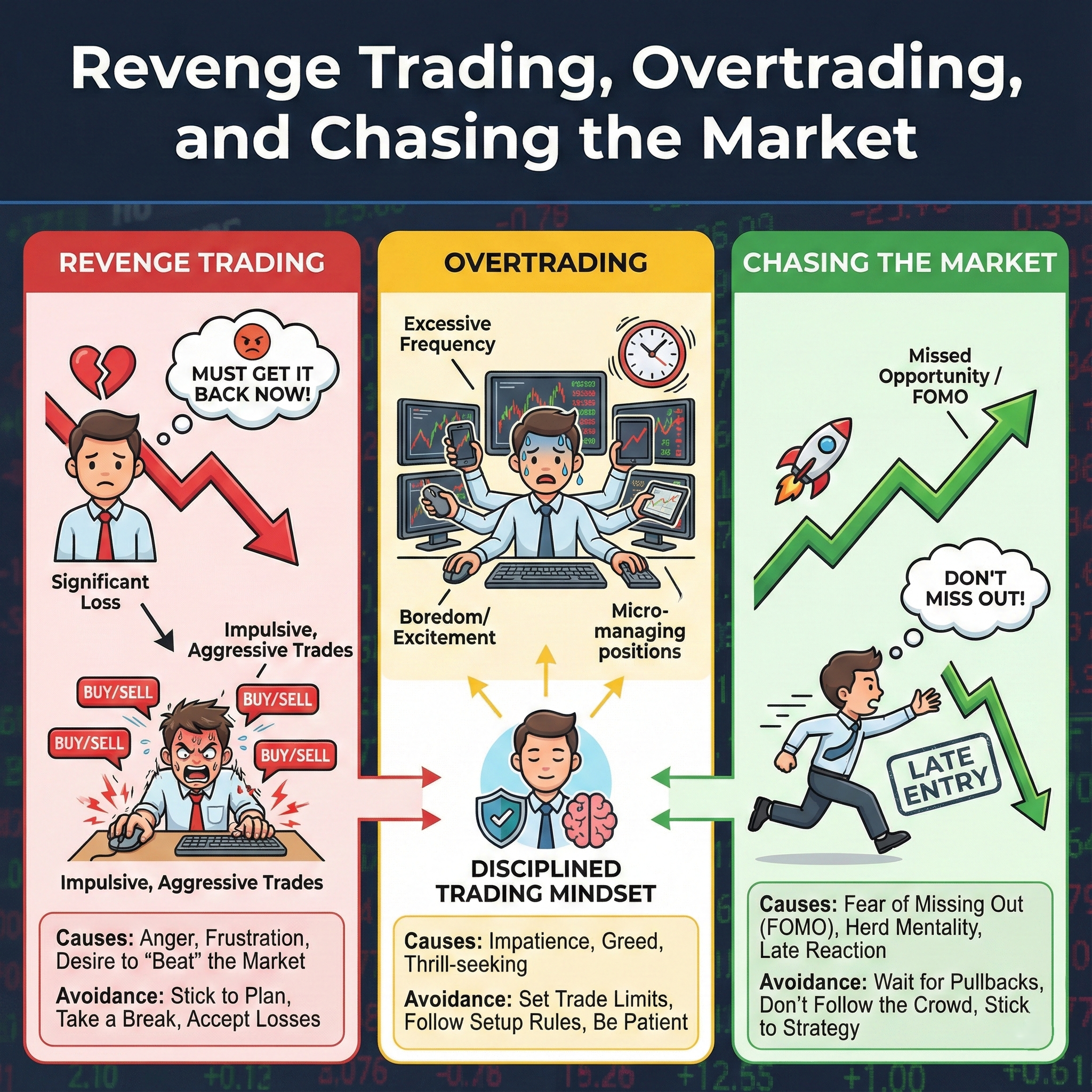
Trading looks simple from the outside, yet every trader soon discovers that the hardest battles happen inside their own mind. Revenge trading, overtrading, and chasing the market push many traders off track before they even understand what went wrong. Although these behaviors seem different on the surface, they all come from the same emotional storm that builds after losses, missed chances, or long stretches of uncertainty. When emotions gain control, logic fades, and the market becomes a stage where fear, frustration, and impatience run the show.
Even skilled traders run into these patterns because the brain reacts to losses as if they threaten survival. The moment fear or anger sparks, decisions shift from calm judgment to impulsive action. However, traders who understand why their mind behaves this way and who build systems that limit emotional influence eventually learn to stay steady when the market tries to shake them.
This guide breaks down each destructive behavior clearly and practically. It explains why traders fall into these traps, how to recognize early warning signs, and how to build habits that protect both confidence and capital. It moves step by step through the psychology, the triggers, the consequences, and the solutions. While the work takes time, the payoff is huge: a calmer mind, a stronger system, and a level of consistency that many traders never reach.
Understanding Revenge Trading: The Fastest Way to Blow Up an Account
Revenge trading begins with a loss that hurts more than expected. A trader might enter a setup they believed in, only to see it fail in a way that feels unfair. Instead of taking time to breathe and evaluate, they jump back into the market intending to get the money back right now. The emotional force behind this behavior feels intense because the brain treats the loss as a threat. As a result, the part of the brain that handles logic and long-term planning becomes quiet, and the emotional side takes the wheel.
Although revenge trading feels like an attempt to fix a problem, it usually creates a bigger one. Traders often increase their position size, take setups they would never touch on a normal day, and ignore every part of their plan. Even worse, they try to beat the market as if the market cares. The market never fights traders; traders fight themselves.
Loss aversion plays a huge role here. People feel the pain of loss far more severe than the joy of an equal gain. A $200 loss feels heavier than a $200 win feels exciting. This imbalance pushes traders to try to erase the emotional sting quickly, yet the chase usually causes even more damage. The urge is strong because the mind tries to escape discomfort rather than accept it.
Common Triggers Behind Revenge Trading
Several situations tend to spark revenge trading:
A large or unexpected loss
When a trader loses more than expected, the shock often triggers an emotional reaction.
A mistake that feels avoidable
If the loss comes from breaking a rule, shame and frustration pile onto the grief.
Getting stopped out before the move
Many traders feel humiliated when they exit at the worst moment, especially if the price reverses soon after.
Watching someone else profit while they lose
Social media exaggerates this effect.
Although these triggers differ in form, they all hit the same emotional nerve: the feeling that the market took something unfairly. The desire to “get it back” grows quickly and clouds all judgment.
A Realistic Scenario
Imagine a trader who loses $500 on a trade they forced. They feel embarrassed and angry the moment they close the position. Instead of stepping away, they scan the charts for anything that moves. Their heart beats faster. Their breathing changes. They ignore their rules and double the position size to “recover fast.” The trade fails. Another $500 disappears. The emotional pressure spikes, and the trader feels trapped in a spiral.
Revenge trading rarely stops after one quick attempt. It often turns into a chain of impulsive trades that grow worse with each loss.
Consequences of Revenge Trading
The damage extends far beyond the money lost:
Rules collapse
The trader stops following the plan that should protect them.
Risk explodes
Position sizes grow out of control.
Confidence breaks
Each impulsive trade drains trust in one’s ability.
Account destruction accelerates
A few revenge trades can erase months of progress.
Although the financial losses sting, the psychological impact cuts deeper. Traders begin to fear their own reactions, and that fear often lingers long after the account recovers.
Recognizing the Signs of Revenge Trading Before It Starts
Awareness saves traders from many disasters. Several signs often appear minutes or even seconds before a revenge trade:
A sudden urge to “win it back now.”
This rush of urgency rarely comes from logic.
Entering trades without checking the plan
If you skip your criteria checklist, the decision likely comes from emotion.
Increasing position size without reason
Sizing up fast is one of the biggest clues.
Ignoring or removing stop-losses
This usually means the emotional brain is taking control.
Fast breathing, tension, or racing thoughts
Physical cues often reveal emotional hijacking before your mind notices.
Feeling shame or frustration from the previous loss
These emotions sit right at the root of revenge trading.
Although these signs appear quickly, they are strong enough to stop the pattern if you catch them early. Many traders reduce revenge episodes by simply learning to notice these signals.
Understanding Overtrading: The Silent Account Drainer
Overtrading doesn’t always feel dramatic. It builds slowly, often disguised as productivity or enthusiasm. A trader looks at the screen and believes every price move deserves a response. Instead of waiting for their best setups, they take whatever appears mildly interesting. Although this seems harmless at first, overtrading consumes capital through both losses and costs.
Impatience drives most overtrading. Traders want action. They want progress. They want movement. When the market slows down, boredom creeps in, and boredom pushes traders to force trades that do not fit their method. Even winning streaks create danger, because confidence rises and blinds traders to risk.
Why Overtrading Happens
Several psychological forces fuel this behavior:
Impatience
Many traders struggle with waiting. The market rewards patience, yet the mind craves action.
Overconfidence after wins
A few successful trades often make traders believe they can outsmart the market at will.
Fear of missing out
Even a small move can make a trader fear missing an opportunity.
Market volatility
Fast moves spark emotional excitement, and excitement clouds judgment.
Because these drivers link to basic human emotions, they hit everyone at some point.
How Overtrading Hurts Performance
The costs add up in ways traders underestimate:
Higher transaction costs
Spreads and commissions chip away at every outcome.
Lower trade quality
More trades usually mean weaker setups.
Increased exposure
Even good strategies lose when applied too frequently.
Emotional fatigue
A tired mind makes sloppy decisions.
Although many traders assume overtrading is harmless, it slowly drains accounts by spreading attention too thin and destroying consistency.
A Practical Example
Consider a trader who plans two to three quality trades each day. However, on a fast-moving day, they take ten trades. Only the planned trades perform well because each setup followed the rules. The rest fall apart because the trader jumped in without strong conviction. At the end of the day, the “extra” seven trades wipe out the profits from the good ones. Although the trader worked harder, they earned less.
This story repeats across thousands of traders every day.
Chasing the Market: The Trap Built by Fear of Missing Out
Chasing happens when traders jump into moves that have already started. They see price running, feel panic about missing profit, and enter late with poor risk-to-reward. They might even convince themselves that momentum will continue forever, yet the run often slows the moment they enter.
Fear of missing out pushes traders into dangerous setups. Moreover, social media amplifies this fear because traders only see others bragging about catching moves. They rarely see the losses behind the scenes.
Why Traders Chase
Several mental biases drive this pattern:
FOMO (Fear of Missing Out)
This fear creates a sense of urgency, even when logic says to wait.
Recency bias
Traders believe what just happened will continue.
Hope for fast gains
Chasing feels like a shortcut, even though it rarely works.
Pressure from watching others profit
The mind compares constantly, and comparison fuels impulsive action.
Although these triggers appear simple, they hijack judgment quickly and create a cycle of poor entries and emotional exits.
Consequences of Chasing
Chasing almost always leads to:
Buying near the tops
Traders enter too late and face immediate reversals.
Taking on larger risks
Because the entry is late, stops must be wider or ignored.
Emotional exhaustion
Chasing leaves traders frustrated and confused.
Loss of confidence
Repeated bad entries crush self-trust.
Even worse, chasing often leads straight into revenge trading when the loss feels unfair.
How These Three Behaviors Connect
Although revenge trading, overtrading, and chasing look different, they share strong roots:
All come from emotional triggers
Fear, shame, boredom, frustration, and excitement spark impulsive decisions.
All break rules
The moment emotions take over, the trading plan disappears.
All damage confidence
Each behavior steals clarity and replaces it with doubt.
Each one often leads to the others.
A trader might chase a move, lose money, then revenge trade, and then overtrade while trying to stabilize.
Although the behaviors appear in different forms, they function like branches of the same tree.
Why These Patterns Keep Happening: How the Brain Works Under Stress
The human brain reacts to market losses the same way it reacts to physical danger. The emotional centers fire instantly, and the thinking centers slow down. Although this sounds dramatic, it happens automatically because survival instincts override calm reasoning.
The amygdala handles emotional responses and is activated when a trader feels threatened. A large loss, a sudden reversal, or a missed opportunity can all trigger this area. Because of this reaction, the brain pushes the trader toward quick action instead of thoughtful analysis. The primitive part searches for fast relief, not long-term success.
Although traders understand proper behavior intellectually, the emotional brain does not care about logic. It reacts to danger in real time. Because of this, willpower alone rarely stops revenge trading or overtrading. However, systems and rules can slow the emotional reaction long enough for logic to return.
The Real Cost: How These Behaviors Destroy Accounts and Confidence
The financial impact is serious, yet the psychological impact often hurts more.
Financial Consequences
Transaction costs rise
Overtrading burns money even when trades break even.
Losses grow in size
Revenge trading and chasing push traders into oversized positions.
Capital erodes faster than expected
A few days of emotional trading can undo months of progress.
Although some traders recover financially, many cannot repair the mental strain.
Psychological Consequences
Confidence collapses
Traders start doubting every decision.
Fear grows
The memory of bad outcomes weighs on future choices.
Avoidance develops
Some traders stop executing good setups because they fear their own mistakes.
The emotional load increases
Stress builds daily until trading feels draining instead of engaging.
When a trader loses trust in themselves, strategy alone cannot save them. Confidence becomes the foundation for discipline.
Opportunity Costs
Losses not only harm the account. They also rob traders of:
Focus
Emotional chaos steals mental energy.
Clear thinking
Frustration fogs analysis.
Good trades
A trader stuck in fear or revenge mode misses real opportunities.
These invisible costs often hurt more than the direct losses.
Prevention Strategy 1: Build a Detailed Trading Plan That Removes Guesswork
A trading plan acts like a shield. It prevents emotional decisions by giving traders clear rules they must follow, no matter how they feel. Although many traders create plans, only a few commit to them relentlessly. Real discipline comes from clarity, not willpower.
The plan should include:
Clear entry criteria
Every trade must meet specific conditions. No exceptions.
Fixed risk per trade
Most traders perform better when limiting each trade to one or two percent of the account.
Stop-loss placement rules
Stops should follow market structure, not emotions.
Position sizing formula
Sizing should adjust automatically based on volatility.
Daily loss limits
When reached, trading stops immediately.
Execution checklist
Before any trade, the trader checks each box.
Although building a plan takes effort, following one reduces emotional trading dramatically.
Why a Trading Plan Helps
Although emotions rise during fast markets, rules keep traders grounded. Each rule creates a barrier between impulse and action. As a result, traders make fewer emotional decisions, even on stressful days. The plan also offers structure and consistency, whichreducese overtrading and chasing.
Prevention Strategy 2: Use Systematic Risk Management That Protects You From Yourself
Strong risk management prevents small mistakes from becoming huge disasters. Because emotions often run high during difficult moments, risk rules must work automatically.
These principles matter most:
Always set a stop-loss
Stops protect you when emotions cloud judgment.
Use fixed risk-to-reward ratios
Ratios like 1:2 or 1:3 ensure winners outweigh losers over time.
Adjust position size during high volatility
Smaller positions reduce stress and prevent panic.
Avoid placing all your risk in one setup
Diversifying reduces emotional intensity.
Although traders initially resist restrictions, risk rules eventually become a source of confidence.
Prevention Strategy 3: Strengthen Emotional Awareness and Psychological Discipline
Trading requires emotional fitness just as much as technical skill. Because of this, traders benefit from tools that calm the mind and build awareness.
Keep a Trading Journal
A journal that tracks emotions alongside trades reveals patterns. Many traders discover that revenge trading follows specific triggers, such as boredom, frustration, or external stress. Although these triggers feel subtle, they show up consistently in journals.
Practice Short Breaks Throughout the Day
Stepping away prevents emotional escalations. A five-minute pause can save hundreds of dollars. Many traders regain clarity simply by walking away from the screen after a loss.
Use Breathing and Mindfulness Habits
Deep breathing slows the emotional response. Mindfulness teaches the brain to observe feelings without reacting to them. Although these practices seem simple, they build stability over time.
Reframe Losses
Viewing losses as part of the learning process removes shame. Every trader faces losses, yet the best ones treat them as data rather than personal failure. This shift reduces the emotional pressure that triggers revenge trades.
Prevention Strategy 4: Build External Accountability Systems
Accountability helps traders stay disciplined because someone else sees their decisions.
Mentorship and Trading Communities
A mentor or group can review trades and point out emotional decisions. Because traders care about how they appear to others, they avoid breaking rules as often when someone is watching.
Commitment Contracts
Writing rules and attaching consequences helps traders stay focused. For example, breaking a daily loss limit might require donating a set amount to charity.
Partial or Full Automation
Many traders remove emotional execution by automating entries or stop losses. Although automation does not solve every issue, it removes the most common mistakes.
Reduce Position Size Temporarily
Smaller sizes lower emotional impact. Because of this, traders can practice discipline without risking heavy losses.
The 48-Hour Rule: A Reset Button That Protects Your Account
After a large loss, emotional reactions often last longer than traders admit. The 48-hour rule stops revenge trading by forcing a pause. When a trader hits their daily loss limit, they take a full two-day break from the market. This pause allows emotions to reset and gives the logical mind time to return.
During this break, traders can:
Review trades with a clear perspective
Reflection works better when emotions settle.
Rebuild confidence
Stepping away reduces stress and restores balance.
Spend time on non-trading activities
Mental distance offers clarity.
Although traders want to return quickly, the delay creates discipline. It also prevents catastrophic losses caused by emotional spirals.
Building Long-Term Mental Resilience
True resilience comes from understanding that emotional impulses never disappear. Even experienced traders feel fear, frustration, and impatience. However, they respond differently. Instead of reacting, they observe. Instead of forcing trades, they pause. Instead of chasing, they wait for setups.
Commit to Continuous Learning
The more traders understand psychology, the better they manage themselves. Books, courses, and communities help traders refine emotional awareness.
Review Performance Regularly
Weekly or monthly reviews reveal patterns. Traders can spot improvements, identify repeating mistakes, and celebrate progress.
Connect With Other Traders
Hearing stories from people who conquered revenge trading or overtrading builds confidence. Success often requires seeing that others have overcome the same challenges.
Recognizing Progress: Improvement Happens in Small Steps
Progress rarely moves in a straight line. Although setbacks will appear, they do not mean failure. If a trader reduces revenge trading episodes from three times a week to once, that counts as real progress. If they notice an urge but pause instead of reacting, that also counts.
Traders improve by changing behavior frequency, not by eliminating every impulse. Even experts slip occasionally, yet they correct quickly and return to discipline.
Conclusion: Your Path to Steady, Disciplined, Confident Trading
Revenge trading, overtrading, and market chasing appear in nearly every trader’s journey. Although painful, these behaviors do not reflect a lack of talent. They simply show how human emotions react under pressure. Once traders understand why these reactions appear and how to manage them, they gain a level of control that transforms their results.
The strategies in this guide work because they align with human psychology instead of fighting it. A clear trading plan, strict risk management, emotional awareness, accountability systems, and structured breaks create a strong foundation. When combined, these tools help traders stay consistent even when the market becomes unpredictable.
Your next step is simple: choose one change from this guide and apply it today. Then build from there. Each step strengthens discipline, reduces emotional noise, and moves you closer to the calm, confident trading style that leads to long-term success.
Because the market will always test you, but with the right structure, you can pass every test with clarity and control.

Leave a Reply