

Introduction
In a rapidly evolving global economy, some industries emerge with the potential to shape the future, redefine standards, and contribute substantially to national development. These are known as “sunrise industries” — sectors in the early stages of development but show significant promise of future growth, employment generation, and innovation. Several sunrise industries are lighting the path to economic prosperity in India, a country characterized by demographic dividends, a large domestic market, and a surge in digital and technological advancement.
This comprehensive blog explores the concept of sunrise industries, highlights the key sectors currently categorized as such in India, evaluates their growth prospects, government support, investment opportunities, and analyzes the challenges that could impact their trajectory.
Understanding Sunrise Industries
A sunrise industry is typically defined by its nascency, innovative character, rapid expansion rate, and transformative impact. These industries often arise due to technological innovations, shifts in consumer preferences, environmental mandates, and supportive government policies. They are crucial to economic diversification and play a crucial role in boosting GDP and exports while creating new job opportunities.
Characteristics of sunrise industries include:
- High growth potential.
- Heavy focus on research, innovation, and technology.
- Capacity to attract foreign direct investment (FDI).
- Government policy support and incentives.
- A significant role in shaping future consumer behavior and business practices.
Major Sunrise Industries in India
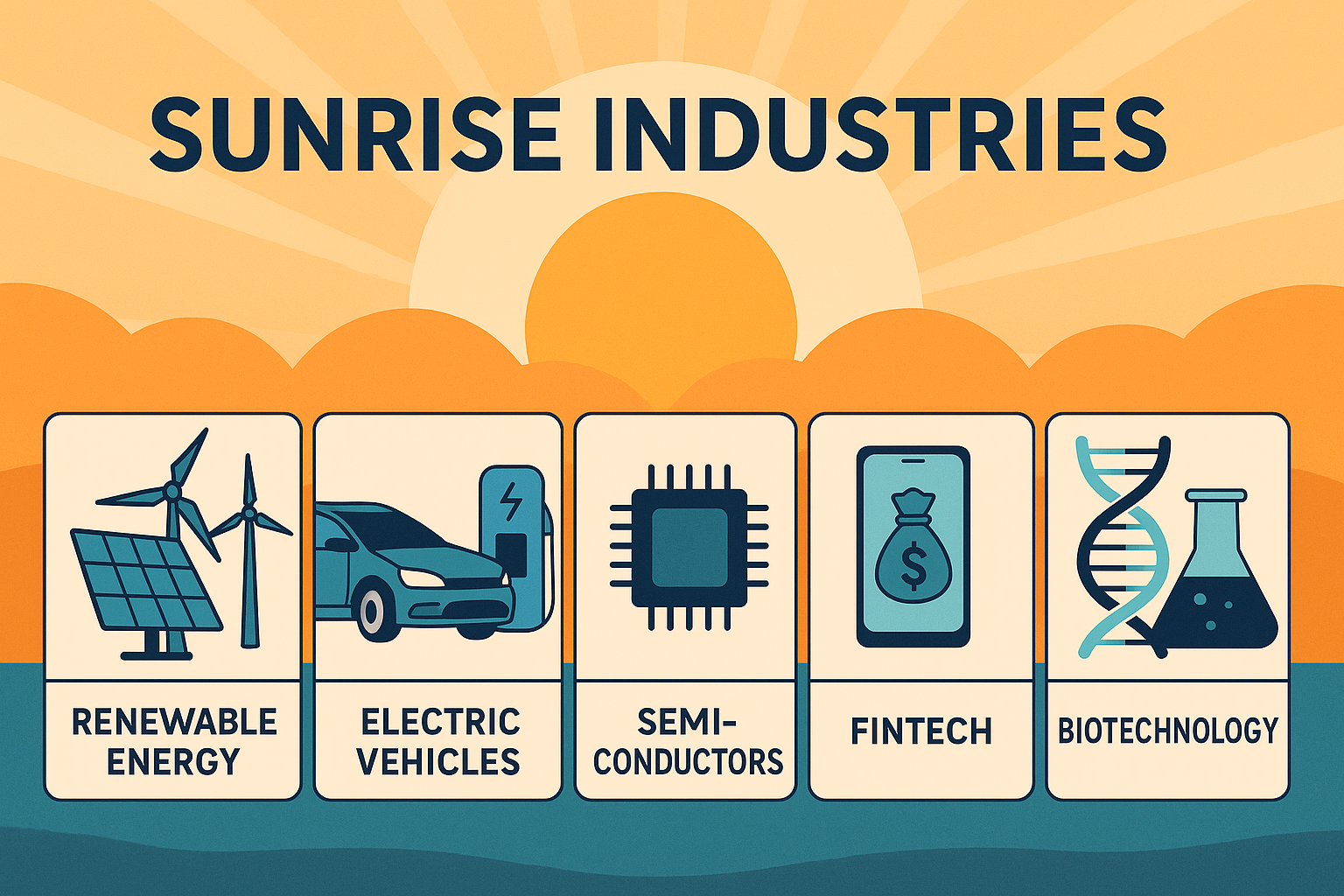
India’s economic landscape is undergoing a metamorphosis driven by several burgeoning sectors. Below are some of the most prominent sunrise industries currently leading the charge:
1. Renewable Energy
India has emerged as one of the global leaders in renewable energy. With ambitious targets and government-backed initiatives, the renewable energy sector is redefining India’s energy framework.
- Current Scenario: India aims to achieve 500 GW of non-fossil fuel-based energy capacity by 2030.
- Key Drivers:
- International climate commitments.
- Reducing dependency on fossil fuels.
- Falling costs of solar panels and wind turbines.
- Government schemes like PM-KUSUM and UJALA.
- Investment Opportunities: Companies such as Adani Green Energy, Tata Power Renewable Energy, and ReNew Power have drawn billions in investment.
- Challenges:
- Land acquisition issues.
- Grid integration of renewable energy.
2. Electric Vehicles (EVs)
The automotive industry is undergoing a major transformation with the advent of electric vehicles. EVs are a major sunrise industry, driven by the need for sustainable mobility and clean energy.
- Government Push: The FAME II scheme, PLI for battery storage, and tax incentives.
- Market Players: Tata Motors, Ather Energy, Ola Electric, and Mahindra Electric.
- Start-up Ecosystem: Strong support from investors and incubation centers.
- Challenges:
- Charging infrastructure.
- High upfront costs.
- Consumer awareness and trust.
3. Semiconductors and Electronics Manufacturing
India has recognized the importance of self-reliance in semiconductor manufacturing, especially after global chip shortages during the COVID-19 pandemic.
- Strategic Importance: Vital for defense, smartphones, automobiles, and IoT devices.
- Government Initiatives:
- $10 billion incentive package under the Semicon India Programme.
- Modified Electronics Manufacturing Clusters (EMC 2.0) Scheme.
- Major Players: Vedanta-Foxconn JV, ISMC, and international tech collaborations.
- Challenges:
- Technological expertise.
- Capital intensity.
4. Fintech and Digital Payments
India’s digital economy has surged with a boom in fintech services, becoming one of the largest markets globally for digital payments and financial innovations.
- Market Size: Projected to reach $150 billion by 2025.
- Key Growth Drivers:
- UPI and Aadhaar-based verification.
- Jan Dhan Yojana and digital India movement.
- Major Start-ups: PhonePe, Razorpay, Paytm, Cred.
- Opportunities:
- Expanding into rural India.
- Innovations in blockchain, neobanking, and InsurTech.
5. Biotechnology and Healthcare
Post-pandemic, India has turned into a hub for healthcare innovation. Biotechnology, vaccine development, telemedicine, and pharmaceuticals are seeing unparalleled growth.
- Government Focus: Biotech parks, funding for genomic research, and PLI schemes.
- Private Sector Involvement: Biocon, Serum Institute of India, Zydus Cadila.
- Key Developments:
- mRNA vaccine research.
- AI-based diagnostics.
6. Artificial Intelligence and Machine Learning
AI and ML are transforming every industry — from agriculture and healthcare to logistics and education. India is home to a rising number of AI start-ups.
- Government Efforts:
- National AI Strategy by NITI Aayog.
- Investments in AI research and data centers.
- Applications:
- Predictive analytics in healthcare.
- Smart agriculture.
- Fraud detection in banking.
Role of Government in Promoting Sunrise Industries
To harness the full potential of sunrise industries, the Government of India has taken significant steps:
- Ease of Doing Business: Simplification of compliance and faster approvals.
- Start-up India and Make in India: Campaigns to support indigenous innovations and manufacturing.
- Production Linked Incentive (PLI) Schemes: Financial incentives to boost domestic production across sectors.
- Sector-Specific Policies: Customized policies for EVs, semiconductors, solar power, etc.
- Digital Infrastructure: BharatNet and Digital India initiatives for high-speed internet access.
Investment Landscape and FDI Inflow
Sunrise industries have attracted considerable attention from both domestic and international investors:
- Venture Capital: Fintech, EVs, and AI start-ups are VC favorites.
- Foreign Direct Investment (FDI):
- 100% FDI is allowed in many sunrise sectors.
- Special Economic Zones (SEZs) offer tax benefits.
- Green Bonds and ESG Investing: Renewable energy companies tapping into sustainable finance.
Challenges Facing Sunrise Industries
Despite their potential, these industries also face significant challenges:
- Regulatory Uncertainty: Changing rules can disrupt investments.
- Infrastructure Gaps: Lack of robust logistics, power supply, and data centers.
- Skilled Workforce: Shortage of talent in emerging technologies.
- Initial Capital Requirement: High costs involved in R&D and setup.
- Market Readiness: Adoption hurdles, especially in tier-2 and rural markets.
Future Outlook
The next decade will witness the full maturation of many of these sunrise industries. They will define the next phase of India’s economic development, boost employment, and make the country self-reliant in strategic areas.
- Green Future: Renewable energy and EVs will help India lead in the global clean energy transition.
- Digital Transformation: AI, fintech, and biotech will revolutionize how we live, work, and heal.
- Atmanirbhar Bharat: Indigenous manufacturing will reduce imports and strengthen India’s global standing.
Conclusion
Sunrise industries are the torchbearers of India’s next economic revolution. By embracing innovation, investing in new technologies, and creating robust support ecosystems, India can harness these sectors to fulfill its trillion-dollar economy dream. The journey from a developing nation to a global leader lies in how effectively we nurture these sunrise sectors.
For aspiring entrepreneurs, investors, and policymakers, the message is clear: the sunrise is now. Seize it before it sets.

Leave a Reply