

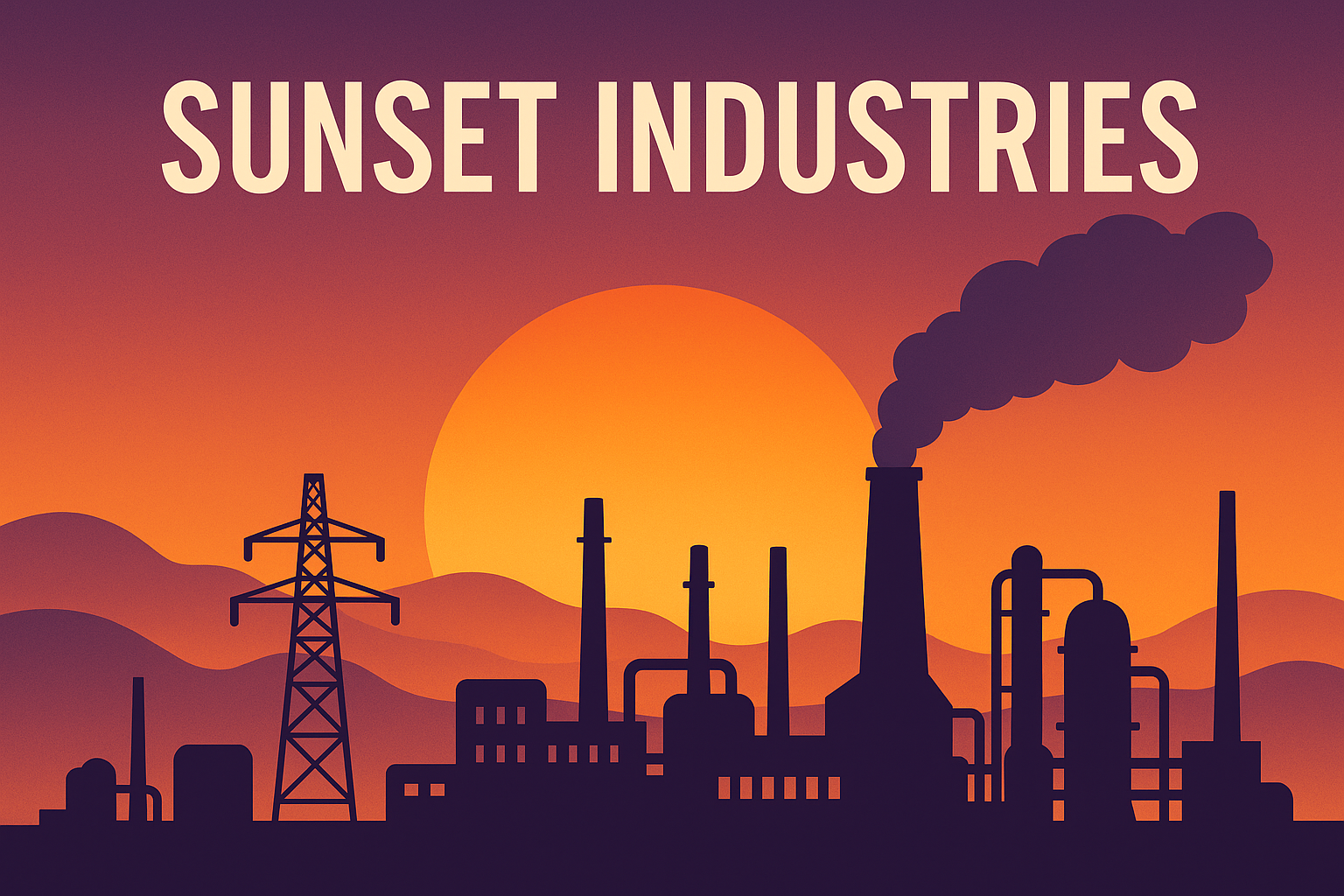
In the ever-evolving economic landscape, industries rise and fall as a natural consequence of technological advancements, globalization, and shifting consumer behaviour. While most attention is typically focused on high-growth, high-potential sectors known as “sunrise industries,” the decline of certain sectors, known as “sunset industries,” deserves equal contemplation. Once the backbone of economies, these industries are now struggling to maintain relevance, profitability, and sustainability.
In this comprehensive blog, we will explore what defines a sunset industry, the driving forces behind industrial decline, notable examples from various parts of the world, the socio-economic impact of these declines, and potential strategies for renewal and transformation. The goal is not just to understand which sectors are fading, but to uncover how legacy systems can be leveraged, repurposed, or evolved in the face of obsolescence.
What is a Sunset Industry?
A sunset industry refers to an industrial sector past its peak in terms of demand, profitability, and innovation. These industries often experience a downward trajectory due to their inability to adapt to new technologies, environmental regulations, or changes in consumer preferences. They are typically labor-intensive, capital-heavy, and resistant to innovation, making their decline more pronounced and disruptive.
Characteristics of Sunset Industries:
- Declining revenues and profitability.
- Shrinking workforce and employment opportunities.
- Aging infrastructure and capital equipment.
- Difficulty attracting investments.
- Technological stagnation.
- High fixed costs with decreasing marginal returns.
Key Causes of Industrial Decline
1. Technological Advancements
Technological disruption is arguably the biggest contributor to the decline of traditional sectors. Automation, artificial intelligence, robotics, and software innovations have transformed the way businesses operate. For instance, the rise of digital photography almost entirely wiped out the analog film industry, while online streaming services rendered DVD and CD manufacturing nearly obsolete.
2. Globalization and Outsourcing
The shift in global trade dynamics has forced industries in developed countries to compete with low-cost production centers in emerging economies. Textile manufacturing, once a flourishing sector in countries like the U.S., UK, and parts of Europe, has moved to nations like Bangladesh, Vietnam, and India.
3. Environmental Regulations
Stricter environmental policies have put pressure on industries that rely on fossil fuels or produce significant waste. Coal mining, for example, has seen a massive decline in countries adopting green energy targets. The automobile industry is being reshaped as combustion engines face extinction due to zero-emission mandates.
4. Consumer Preference Shifts
Consumers today demand more personalized, eco-friendly, and tech-integrated products. This evolution has rendered many traditional products outdated. For example, the decline of print newspapers is driven by the consumer’s preference for digital news platforms that are immediate, interactive, and customizable.
5. Policy and Trade Barriers
Sudden policy shifts or protectionist measures can sometimes create volatility that speeds up the decline of certain industries. Tariffs, sanctions, or import restrictions can drastically alter an industry’s ability to stay competitive in global markets.
Examples of Sunset Industries Across the World
1. Coal Mining and Thermal Power Plants
As countries transition to cleaner sources of energy, coal has become an increasingly unviable energy source. In the United States, coal’s share of electricity generation dropped from 50% in 2005 to less than 20% in 2023. India and China, while still reliant on coal, are investing heavily in solar and wind.
2. Print Media and Publishing
The print newspaper industry is a textbook example of a sunset sector. Newspaper circulation in the U.S. dropped from 60 million in the 1990s to less than 20 million in 2020. Meanwhile, digital journalism, blogs, and social media platforms have taken over information dissemination.
3. Cable Television Networks
With the rise of on-demand streaming services such as Netflix, Disney+, and Amazon Prime, cable TV is on a rapid decline. Younger generations prefer content that is available on-demand, without ads, and accessible via smartphones.
4. Textile and Apparel Manufacturing in Developed Nations
Once a significant employer in countries like the U.S., UK, and Germany, textile manufacturing has largely moved to countries with cheaper labor. The result is an industry that has shrunk dramatically in its original strongholds.
5. Analog Photography
The digital camera revolution rendered analog photography and film rolls obsolete. Kodak, once a behemoth, filed for bankruptcy in 2012 after failing to adapt to the digital era in time.
6. Postal Services
With the rise of email, instant messaging, and digital document sharing, traditional postal services are struggling. While parcel services have grown due to e-commerce, letter delivery has sharply declined.
Socio-Economic Impact of Declining Industries
1. Job Loss and Unemployment
Industries that fade often leave behind a trail of unemployment. Workers, especially those in blue-collar jobs, may find it difficult to retrain or find new employment in tech-driven sectors.
2. Urban Decay
Cities built around certain industries (like Detroit for automobiles) often suffer economic and infrastructural decline when those industries fade.
3. Skill Obsolescence
Older generations of workers often find their skills irrelevant in modern workplaces, necessitating significant retraining and upskilling.
4. Mental Health Issues
Long-term unemployment and the feeling of being left behind by progress can lead to a spike in mental health issues, addiction, and crime in affected communities.
Can Sunset Industries Rise Again?
Though the term “sunset” suggests inevitable demise, history shows that sectors can reinvent themselves.
1. Digital Transformation
Print media has evolved into digital subscriptions. For instance, The New York Times generates more revenue from its online content today than from print. Similarly, Kodak has pivoted into digital imaging and pharmaceutical chemicals.
2. Niche Markets and Premium Branding
Some industries have found second life in premium niches. Vinyl records, once dead, have made a comeback among audiophiles. Handmade goods, artisan products, and vintage items have revived interest in dying crafts.
3. Green Transition
Heavy industries like steel and mining are now looking at green alternatives, including hydrogen-based processes and carbon capture technologies. With government incentives, these sectors could evolve rather than die out.
4. Mergers and Acquisitions
Struggling companies are often absorbed by larger, more modern firms. This can lead to a strategic overhaul that brings dying brands back into relevance.
Policy Measures for Managing Industrial Decline
1. Reskilling and Education
Government programs that focus on vocational training, digital literacy, and lifelong learning are essential to integrate workers into newer sectors.
2. Support for Startups and Innovation
Encouraging entrepreneurship among displaced workers can create a culture of innovation and help fill the employment gap.
3. Regional Development Funds
Regions heavily dependent on dying industries need targeted investment to diversify their economic base. Infrastructure projects, green energy initiatives, and tourism development can help.
4. Green Tax Incentives
To facilitate the transition, tax incentives and subsidies can be provided to companies investing in green technology or sustainable alternatives.
Conclusion: Embracing Change with Strategic Foresight
Sunset industries are not just about decline; they are a reflection of an economy’s natural evolution. While the process may be painful for some stakeholders, it opens up room for innovation, sustainability, and progress. Governments, businesses, and workers must collaborate to ensure that transitions are just and inclusive.
The ultimate goal should not be to prevent industries from declining but to ensure they evolve, contribute to new sectors, or gracefully exit without causing irreversible social or economic damage. By learning from the past and anticipating the future, we can manage industrial decline not as a threat, but as an opportunity.

Leave a Reply