

Introduction
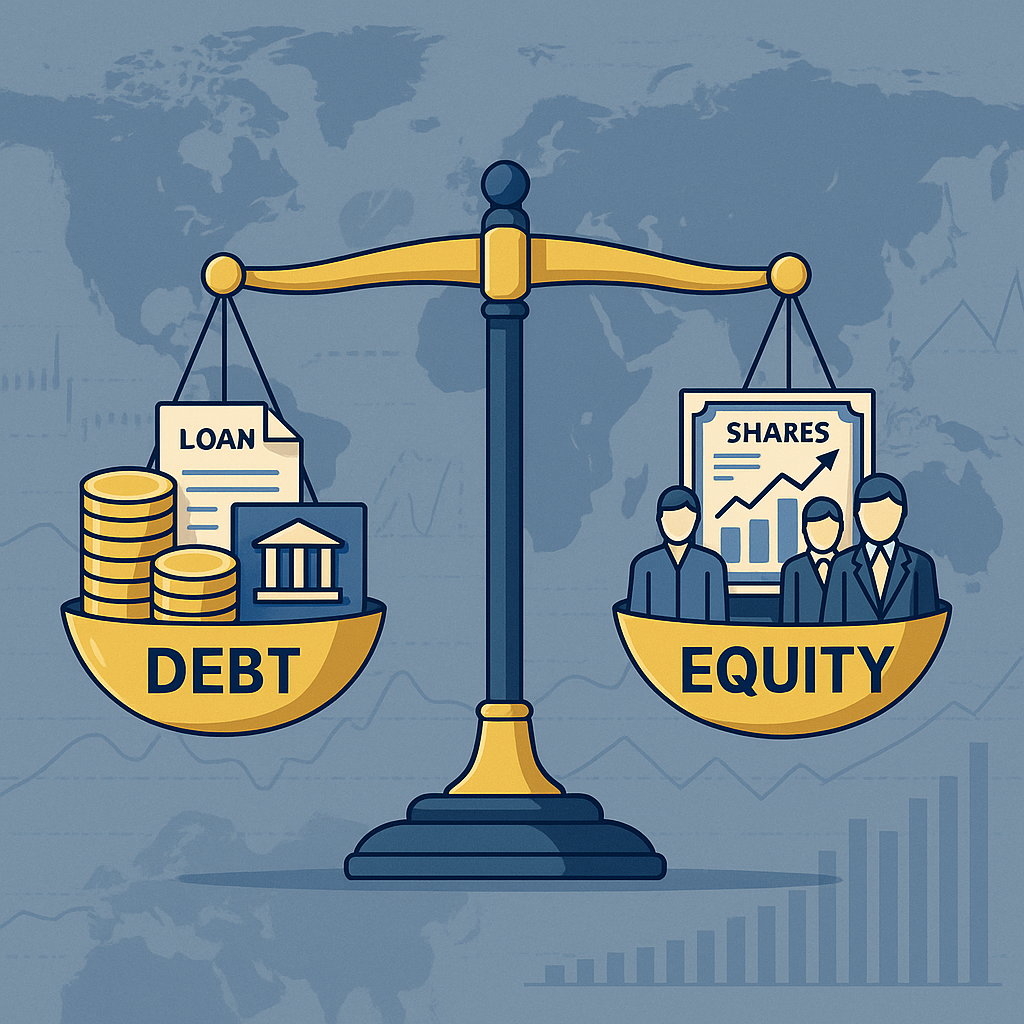
Every company, no matter its size or industry, relies on a mix of debt and equity to fund operations. How that balance is managed determines whether a business grows sustainably or risks collapsing under financial pressure. The Debt-to-Equity Ratio (D/E) is one of the simplest yet most powerful tools to gauge that balance. It tells you how much of a company’s financing comes from borrowing compared to what’s funded by owners or shareholders.
After recent global events-from economic slowdowns to interest rate hikes-investors and business owners are paying closer attention to leverage than ever. When debt becomes too high, it can erode profits and make survival harder in volatile markets. However, avoiding debt entirely can also mean missing out on opportunities to scale, innovate, and compete globally.
Understanding how much leverage is healthy is crucial. This guide breaks down what the debt-to-equity ratio means, how to calculate it, what’s considered safe, and how you can use it to assess financial health-whether for your own company or one you’re planning to invest in.
What Is the Debt-to-Equity (D/E) Ratio?
At its core, the D/E ratio measures how much debt a company uses for every dollar of equity. It shows how the company finances its assets-through borrowed money or through shareholders’ investment.
Formula:
Debt-to-Equity Ratio = Total Liabilities / Shareholders’ Equity
If a company has total liabilities of $2 million and shareholders’ equity of $1 million, its D/E ratio is 2:1. This means the company uses $2 of debt for every $1 of equity.
Debt represents what the company owes-bank loans, bonds, or any borrowed funds. Equity, on the other hand, shows the owners’ investment, including retained earnings and shares issued. Together, they reveal the foundation on which a business operates.
To make it simpler, imagine two businesses:
- Company A funds its projects with $1 million in equity and no debt.
- Company B funds $1 million in equity but borrows another $2 million.
While Company B can expand faster, it also carries higher risk if sales drop or interest costs rise.
Globally, companies use leverage differently. For instance, Japanese firms are often more conservative, maintaining lower D/E ratios, while American and European corporations may rely more on debt for expansion. The ratio thus reflects not just company strategy but also regional economic culture.
How to Calculate the D/E Ratio?
Calculating this ratio is straightforward, but interpreting it correctly takes some care.
Step 1: Find total liabilities on the balance sheet.
This includes both short-term and long-term debt, such as bank loans, bonds, or lease obligations.
Step 2: Identify shareholders’ equity.
This figure represents total assets minus total liabilities. It includes paid-up capital, reserves, and retained earnings.
Step 3: Divide total liabilities by shareholders’ equity.
For example:
If a company has $5 million in liabilities and $2.5 million in equity, the D/E ratio is 2.0.
However, one common mistake is using only long-term debt instead of total liabilities. While some analysts prefer focusing on long-term debt for a clearer picture, the broader version helps you see all financial commitments.
Let’s take Tesla as an example. Over the years, Tesla has maintained a moderate D/E ratio, balancing heavy investment in production with shareholder funding. The ratio fluctuates as the company issues more shares or repays debt. Comparing Tesla to a bank, though, would be misleading since financial institutions naturally carry much higher D/E ratios as part of their business model.
What a Healthy D/E Ratio Looks Like
There’s no universal “perfect” D/E ratio. What’s considered healthy varies by industry, region, and economic environment. Still, understanding benchmarks helps you assess whether a company is overextended or managing debt responsibly.
In capital-intensive industries like airlines, telecom, or manufacturing, higher D/E ratios are normal because companies need large amounts of borrowed capital to finance equipment and infrastructure. A ratio of 2 or even 3 might be acceptable.
In contrast, tech and service sectors often have lower D/E ratios since they rely more on intellectual property and less on physical assets. Ratios below 1 are common here.
The macroeconomic context matters too. When interest rates are low, companies can afford to take on more debt since repayment costs are manageable. However, when global borrowing costs rise-as seen in recent years-those same ratios can quickly become risky.
- So instead of chasing a specific number, investors should ask: Can this company comfortably service its debt while maintaining growth?
High Debt-to-Equity Ratio: What It Means
A high D/E ratio means the company depends heavily on borrowed funds. This approach can be both a blessing and a curse.
On the upside, leverage amplifies returns. Borrowed money lets businesses expand faster, invest in research, or capture market share without diluting ownership. For example, many successful companies, including multinational conglomerates, used strategic borrowing to accelerate global growth.
However, too much debt magnifies losses during downturns. If revenue falls, fixed interest payments still need to be made. Over time, this can strain cash flow, reduce flexibility, and increase the risk of insolvency.
The 2008 financial crisis showed what happens when leverage spins out of control. Many firms, including major banks, collapsed because their debt levels far exceeded their ability to repay.
Today, investors and rating agencies carefully watch leverage ratios. A company with a high D/E ratio might still be fine if it has consistent cash flow and solid assets. But when the economy weakens or credit tightens, those same numbers can turn dangerous quickly.
Globally, the tolerance for leverage differs. U.S. firms often operate comfortably with higher debt loads, while Asian companies typically prefer stronger balance sheets. Understanding this difference is key for international investors.
Low Debt-to-Equity Ratio: Strength or Missed Opportunity?
A low D/E ratio signals financial stability and conservative management. It shows that a company funds operations mainly through its own equity rather than relying on borrowed money. In uncertain markets, this often translates to investor confidence.
Still, being too conservative has its drawbacks. Without some level of borrowing, companies might miss growth opportunities or struggle to scale efficiently. Debt, when used wisely, acts like fuel for expansion.
Take global tech giants as an example. Many hold billions in cash reserves and maintain low D/E ratios, which gives them resilience. Yet, companies like Apple have also issued bonds even when they didn’t need to borrow-mainly to take advantage of low interest rates and optimize capital structure.
So, the goal isn’t zero debt. It’s finding a balance-enough leverage to grow, but not so much that it threatens stability.
Comparing Companies Across Borders
When comparing leverage globally, context matters. Economic environments, tax laws, and even cultural attitudes toward borrowing shape how much debt a company takes on.
In emerging markets, debt may be harder to access or more expensive, leading to lower D/E ratios. In contrast, developed economies often have well-developed credit systems that make borrowing cheaper and more common.
Currency stability also plays a role. Companies in countries with volatile currencies face additional risks when borrowing in foreign denominations. For example, a firm in Brazil with U.S.-dollar debt might see its repayments soar if the real weakens.
Meanwhile, regulations differ widely. Some European countries encourage equity financing through tax incentives, while others favor debt by allowing interest payments to be tax-deductible.
That’s why investors evaluating global stocks must look beyond numbers. The same D/E ratio might signal caution in one market and overextension in another.
How Investors Use the D/E Ratio?
For investors, the D/E ratio offers quick insight into a company’s risk profile. However, it’s rarely analyzed in isolation.
Analysts often compare it with other ratios such as Return on Equity (ROE), Current Ratio, or Interest Coverage Ratio to understand how effectively a company uses leverage. For instance, a firm with a high D/E ratio but strong ROE might be using debt productively. On the other hand, high leverage with weak profits could signal trouble.
In stock valuation, leverage affects both risk and reward. Investors expect higher returns from highly leveraged companies because of the added risk. Therefore, when evaluating an investment, understanding the D/E ratio helps balance potential profit against financial vulnerability.
For long-term investors, steady and manageable leverage is often a sign of disciplined management and financial prudence.
Improving Your Company’s D/E Ratio?
If your company’s D/E ratio looks unhealthy, don’t panic. There are practical ways to strengthen it.
1. Refinance debt: Replace high-interest loans with lower-cost options to reduce liabilities.
2. Issue new equity: Bringing in new investors increases the equity base, improving the ratio.
3. Retain profits: Instead of distributing all earnings as dividends, reinvest some back into the business to grow equity.
4. Boost efficiency: Increasing profitability naturally improves the balance between debt and equity.
However, these changes take time. A sustainable approach works better than a quick fix. Overleveraged companies often try to offload debt too fast, which can disrupt operations. Gradual improvement supported by strategic planning builds long-term stability.
Common Myths About the D/E Ratio
Despite its simplicity, the D/E ratio is often misunderstood. Let’s clear up a few myths:
- Myth 1: A high D/E ratio always means danger.
Not necessarily. Some industries thrive with high leverage because their assets generate steady income to cover debt. - Myth 2: A low D/E ratio always means safety.
That’s not always true either. A company may be underusing its resources and missing growth opportunities. - Myth 3: One ratio fits all.
Every sector has its own standard. Comparing a bank’s ratio with a software firm’s doesn’t make sense. - Myth 4: The D/E ratio never changes.
In reality, it fluctuates with profits, capital injections, and debt repayments. Tracking it over time offers far more insight than looking at a single number.
Conclusion
Debt is neither good nor bad on its own. What matters is how it’s managed. The debt-to-equity ratio helps measure that balance and reveals whether a company is growing sustainably or taking on too much risk.
For investors, it’s a key signal of financial health. For business owners, it’s a guide to structuring capital wisely. The right level of leverage fuels progress, while excessive borrowing can quickly become a burden.
In a world where markets shift fast and credit conditions change overnight, understanding your company’s leverage isn’t optional-it’s essential. By keeping an eye on the D/E ratio, comparing it within your industry, and adjusting your financial strategy accordingly, you ensure that growth stays both ambitious and secure.

Leave a Reply