

Introduction
When people start investing, they often run into a common question: should they grow their money through mutual funds or buy stocks directly? Both options can build wealth, but they work very differently. Understanding how they behave, what they demand from you, and what kind of risks they carry will help you choose the path that matches your goals and temperament.
Key Takeaway
Mutual funds offer a balanced, professionally managed, and diversified way to invest. They work well for beginners or anyone who doesn’t have the time to follow the market closely. Direct stock investing can deliver higher returns, but only if you’re willing to learn, research, and stay disciplined through ups and downs. The right choice depends on your knowledge, patience, risk tolerance, and how involved you want to be.
Understanding Mutual Funds
What Are Mutual Funds?
A mutual fund collects money from many investors and puts it into a basket of stocks, bonds, or other securities. A professional fund manager decides where to invest based on the fund’s objective. When you invest, you buy units of this pool, and your returns depend on how those underlying investments perform.
How Do They Work?
Think of it as a group of friends pooling money to order a big pizza. Instead of each person buying their own separate meal, they hire an expert to choose the ingredients and prepare something better than what they could make alone. Everyone gets a share of the final result.
How to Invest in Mutual Funds: Four Simple Steps
- Select your financial goal.
- Pick a fund category that matches your risk level.
- Decide the amount and duration.
- Start an SIP or make a lump sum investment.
Main Benefits of Mutual Funds
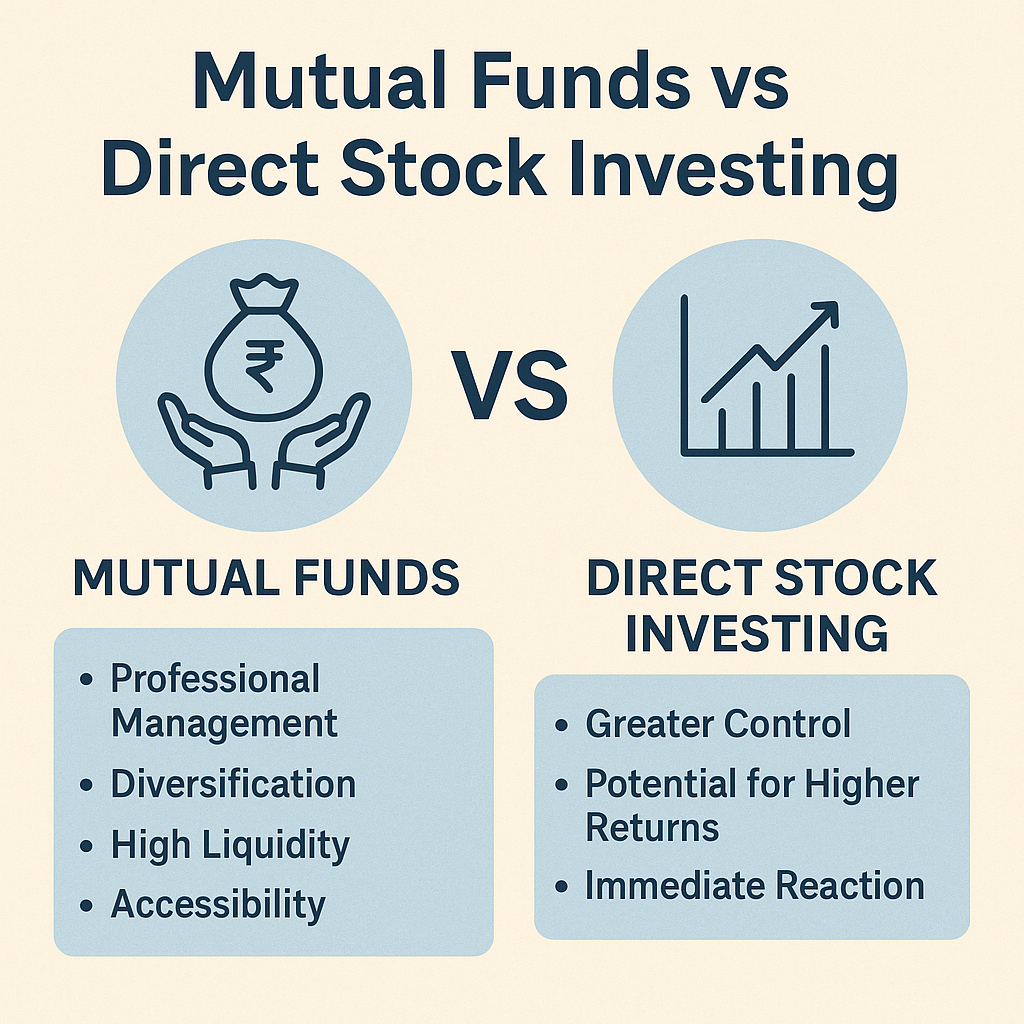
- Professional management
- Diversification across assets
- Easy entry and exit
- Low minimum investment
- Transparent and regulated
Who Should Choose Mutual Funds?
They’re ideal for beginners, salaried individuals, and anyone who wants a low-stress, hands-off approach. If you prefer simple, steady investing without daily market tracking, mutual funds fit well.
Types of Mutual Funds
- Equity funds: For long-term growth.
- Debt funds: For stability with lower risk.
- Hybrid funds: For a mix of growth and safety.
- Index funds: Passive funds that mirror an index.
- Solution-oriented funds: Tailored for goals like retirement or education.
Direct Stock Investing Explained
What Does It Mean?
Here, you buy shares of individual companies on your own. You pick the stocks, decide when to buy or sell, and build your own portfolio. The control is entirely in your hands.
Advantages
- Full control over your decisions
- Potential for high returns
- Ability to react instantly to news or market changes
Disadvantages
- Higher risk because there’s no built-in diversification
- Requires strong research skills
- Emotional swings can affect decisions and returns
Who Should Invest in Stocks Directly?
This approach suits people who enjoy analysing companies, can spare time regularly, and are comfortable with volatility. It’s not passive. It demands patience and a steady hand during market swings.
Key Differences Between Mutual Funds and Direct Stock Investing
| Category | Mutual Funds | Direct Stocks |
|---|---|---|
| Management | Professionally managed by experts | You manage everything yourself |
| Risk Level | Lower due to diversification | Higher because each stock carries its own risk |
| Returns | Stable, risk-adjusted returns | Can be high, but inconsistent |
| Time Required | Minimal; passive approach | High; needs regular tracking and research |
| Control | Limited, handled by fund manager | Full control over buying and selling |
| Diversification | Built-in, across many securities | Must be created by the investor |
| Cost | Expense ratio and possible exit load | Brokerage charges, no recurring fee |
| Best For | Beginners and busy individuals | Experienced investors are comfortable with risk |
Performance: Past Returns and What the Numbers Suggest
Long-term data show a clear pattern. Individual stocks can outperform mutual funds, but only if you pick strong companies early and hold on through volatility. Mutual funds generally deliver more consistent, risk-adjusted returns for most investors. Outliers like HDFC Bank or Infosys do exist, but identifying future winners isn’t easy.
Costs, Fees, and Taxes
Mutual Funds
- Expense ratio: 0.5% to 2.5% yearly
- Exit load: Charged if you withdraw too soon
- Commission: Applies to regular plans; direct plans avoid this
Direct Stocks
- Brokerage: Paid each time you buy or sell
- Demat account: Required to hold shares
- No ongoing expense ratio
Cost Comparison
| Cost Category | Mutual Funds | Direct Stocks |
|---|---|---|
| Expense Ratio | 0.5%–2.5% annually | None |
| Brokerage | Usually lower | Per trade |
| Distribution Fees | Only in regular plans | None |
| Account Requirement | Not required | Mandatory Demat/Trading A/C |
Common Mistakes Beginners Make
With Mutual Funds
- Chasing high returns from last year
- Ignoring risk levels
- Not checking expense ratios
- Switching funds too often
With Direct Stocks
- Poor diversification
- Emotional buying or selling
- Following the tips instead of doing research
- Not monitoring the portfolio
- Ignoring taxes and fees
The Psychology of Investing
Emotions play a bigger role than most people realise. Mutual funds reduce the impact of fear and greed because the manager follows a set strategy. Direct stock investors often fall into traps like overconfidence, panic selling or holding loss-making stocks for too long.
Risk and Diversification
Mutual funds spread investments across many companies, keeping the impact of a single poor performer low. Direct stock portfolios can be heavily affected by bad news related to just one company if they aren’t properly diversified.
Tax Rules
Equity mutual funds and direct stocks share similar taxes on long-term gains in India. But mutual funds offer a hidden benefit: internal buying and selling inside the fund doesn’t create a tax event for you. Direct stock investors pay tax each time they record a gain.
Which Is Better for Beginners?
Mutual funds are usually the safer starting point because they require less knowledge and offer natural diversification. Direct stocks work well for people who want more control and are willing to dedicate time to research.
How to Get Started
For Mutual Funds
- Define your goal
- Pick a suitable scheme
- Choose an amount
- Start with SIPs or lump sum
For Direct Stocks
- Open a demat and trading account
- Research companies deeply
- Start small and diversify
- Review your portfolio regularly
SIPs vs Lump Sum
SIPs help you invest steadily and reduce the impact of market swings. While you can also buy stocks regularly, SIPs in mutual funds offer structure and smoother risk management.
The Best Strategy: Use Both
Most investors benefit from a blend. Mutual funds can form the stable base of your portfolio. Direct stocks can add higher growth potential once you gain experience.
Conclusion
Mutual funds are a simple and reliable way to invest, offering diversification and expert management. Direct stock investing offers more control and possibly higher returns but requires time, knowledge, and emotional discipline. The right choice depends on what you want, how much time you can commit, and how comfortable you are with risk. Once you understand both paths, you can choose the one that aligns with your goals and helps you build wealth confidently.

Leave a Reply