

Introduction
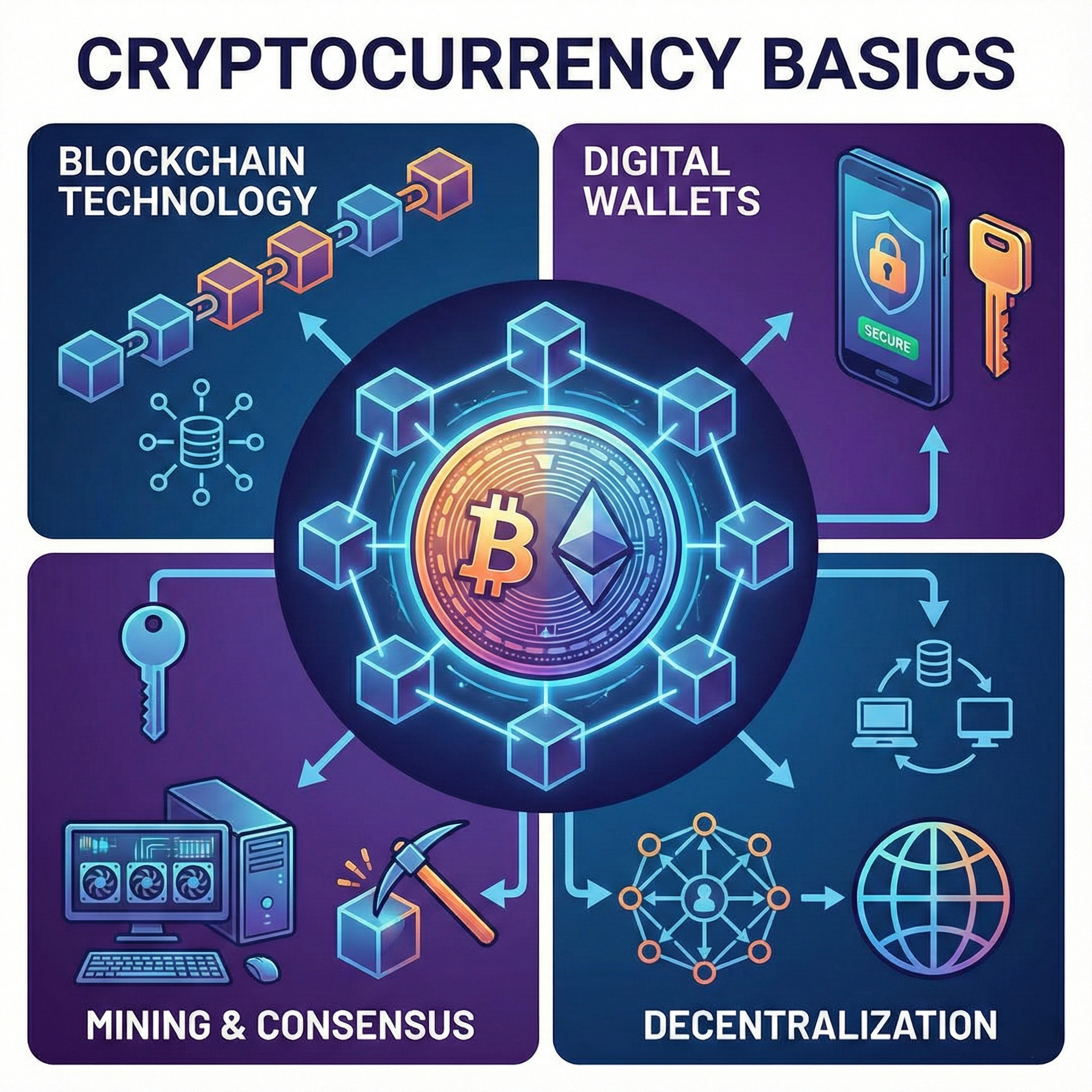
Cryptocurrency is a major financial innovation that has reshaped how we think about money, digital assets, and online transactions. Whether you’re curious about Bitcoin, Ethereum, or any other digital currency, this guide will walk you through the core ideas in simple, clear language. You’ll learn what cryptocurrency is, how it functions, why it has become so important, and what steps you can take to get started. By the end, you should feel confident about the fundamentals and understand why millions of people around the world are exploring digital currencies.
What Exactly Is Cryptocurrency?
Cryptocurrency is best understood as digital money that exists only on computers and the internet. It has no physical form like the cash in your wallet. Bitcoin is the most popular example, and it doesn’t exist as any tangible coin or bill. Instead, cryptocurrency relies on cryptography, which uses advanced mathematical techniques to secure transactions and manage the creation of new coins. Think of cryptography as an invisible lock-and-key system that protects your funds and keeps your transactions safe.
A key feature of cryptocurrency is that it isn’t controlled by any bank, company, or government. Instead, it operates on a decentralized network of computers around the world. These computers verify transactions and keep the system running. Because there’s no middleman, no single authority can freeze your account or stop a transaction. Transfers are generally faster than traditional banking since they don’t require third-party approvals. You can send cryptocurrency across the world in minutes, making it especially useful for global payments.
Understanding Blockchain Technology: The Backbone of Cryptocurrency
Blockchain and cryptocurrency go hand in hand. You can think of a blockchain as a huge digital ledger that records every transaction in a transparent and verifiable way. Transactions are grouped into “blocks,” and these blocks are connected in chronological order, forming a chain secured by mathematical algorithms.
In practice, every few minutes, a new block of recent transactions is added to the chain. It’s similar to adding a new page to a permanent record book. Once a block is added, it can’t be changed or erased. If anyone tries to alter past data, the entire network would spot the inconsistency immediately.
This ledger isn’t stored in one location. Instead, thousands of computers hold full copies of the blockchain, making it extremely difficult to hack or manipulate. A hacker would need to overpower more than half of the network at once, which is nearly impossible. This is why blockchains like Bitcoin have operated for many years without major security failures. The system is transparent, but identities can remain private because only wallet addresses are visible.
How Do Public and Private Keys Keep Your Cryptocurrency Safe?
When you own cryptocurrency, you’ll use two important tools: public and private keys. Your public key is like your bank account number. You can share it with anyone who wants to send you cryptocurrency. Your private key is more like your password or PIN. It must be kept secret because it gives you access to your funds.
If you want to send cryptocurrency, you use your private key to digitally sign the transaction. This signature proves you authorized it. If someone steals your private key, they can take your funds. If you lose it and have no backup, your cryptocurrency could be gone forever.
The two keys are mathematically linked, but it’s nearly impossible to guess the private key from the public one. Modern wallets manage these keys in the background so you don’t have to deal with the technical side. Still, protecting your private key or its backup is essential.
Mining and How New Cryptocurrency Gets Created
Mining is the process that keeps certain cryptocurrency networks running, but it has nothing to do with physical digging. Instead, miners use computers to solve complex math problems that confirm transactions and add them to the blockchain. When they succeed, they receive newly created coins along with transaction fees.
On the Bitcoin network, miners compete to solve each puzzle. The first one to solve it gets to add the next block and earns a reward. Because the process requires powerful hardware and significant electricity, only miners with the right equipment can compete effectively. The network automatically adjusts the difficulty of these puzzles so blocks are added at a steady pace.
Mining consumes a lot of electricity, which has led some newer cryptocurrencies to adopt more energy-efficient methods. Mining is still essential for Bitcoin because it maintains the security and growth of the blockchain. Over time, Bitcoin’s mining rewards are reduced, which affects how new coins enter circulation.
Proof of Work vs. Proof of Stake: Two Different Consensus Methods
Cryptocurrency networks need a method for verifying transactions and agreeing on which ones are valid. This is known as a consensus mechanism. The two most common systems are Proof of Work (PoW) and Proof of Stake (PoS).
Proof of Work, used by Bitcoin, relies on miners solving difficult mathematical tasks. This requires large amounts of computing power but is highly secure. Changing old transactions would require redoing all the work, which is nearly impossible. The main drawback is the heavy energy use.
Proof of Stake works differently. Instead of solving puzzles, validators lock up or “stake” their cryptocurrency as collateral. The network then chooses validators to add new blocks. Those with more staked coins have better odds of being selected. If someone attempts fraud, the network can destroy part of their stake as punishment. PoS uses far less energy and has become increasingly popular.
Both systems have strengths and weaknesses. PoW is time-tested and very secure, while PoS is more efficient. Different projects choose the mechanism that fits their goals.
Different Types of Cryptocurrencies Explained
Bitcoin may be the best-known cryptocurrency, but there are thousands of others. They generally fall into a few major groups.
Payment-focused cryptocurrencies like Bitcoin and Litecoin are designed to function as digital money. They aim to make payments faster, cheaper, and more efficient than traditional banking.
Utility tokens are built on existing blockchains and serve specific purposes. Ethereum is the most well-known example. ETH is used to pay for transactions, run applications, and interact with smart contracts on the Ethereum network.
Stablecoins are designed to maintain a stable price by being linked to a currency like the US dollar. Coins like USDT and USDC aim to stay at a 1-to-1 value with the dollar. They are useful for trading because they avoid the price swings common in other cryptocurrencies.
Altcoins are any cryptocurrencies other than Bitcoin. They include a wide variety of projects, from privacy-focused coins like Monero to systems like Cardano that emphasize sustainability. Each altcoin usually brings its own unique features.
Smart Contracts and Decentralized Finance (DeFi): The Future of Money
Smart contracts are programs that automatically execute agreements when specified conditions are met. You can think of them as digital rules that enforce themselves without human involvement. For example, a smart contract can automatically process a loan, collect interest or transfer funds once certain requirements are met.
Decentralized Finance, or DeFi, is built entirely on smart contracts. DeFi platforms let people lend, borrow, trade, and earn interest without relying on banks. Because everything runs through code, these services are available around the clock and often charge lower fees.
For example, someone can lend cryptocurrency on a DeFi platform and earn interest. The smart contract handles everything: matching borrowers, collecting interest, and managing collateral. Borrowers deposit cryptocurrency as security, and the contract enforces the rules automatically. DeFi has grown massively and now manages huge amounts of digital assets.
Cryptocurrency Wallets: Where and How You Store Your Coins
To own cryptocurrency, you need a wallet. This software stores your digital assets and manages your keys. Different wallets offer different levels of security and convenience.
Software wallets run on your computer or phone and are easy to use, but vulnerable if your device is hacked. Hardware wallets are physical devices that store your keys offline, protecting them from online attacks. You must connect the device to make transactions.
Web wallets operate in your browser, making them convenient but less secure since your keys are stored on the provider’s servers. Paper wallets store your keys on printed paper. They are secure if kept saf,e but less practical to use.
A crucial concept is the seed phrase, a list of 12 to 24 words used to recover your wallet. If you lose your device or wallet file, the seed phrase restores everything. Anyone who has your seed phrase can take your funds, so storing it securely is essential.
Getting Started: How to Buy Your First Cryptocurrency
Buying cryptocurrency is simpler than many people expect. You start by choosing a cryptocurrency exchange such as Coinbase, Kraken, Gemini or eToro. Each platform has different features and fees, so comparing them is useful.
After selecting an exchange, you create an account and complete identity verification through KYC requirements. This involves sharing personal details and an ID. Exchanges do this to prevent fraud and meet regulations. You then link your bank account, deposit money and prepare to buy cryptocurrency.
Once your funds are available, you can browse the list of cryptocurrencies and choose the one you want. Each coin has a symbol such as BTC for Bitcoin or ETH for Ethereum. You can buy small amounts rather than a whole coin. Beginners often start with small investments.
After buying cryptocurrency, it’s safer to move it to a personal wallet instead of leaving it on the exchange. Exchanges have been hacked in the past, so it’s best not to store large amounts there.
Advantages of Cryptocurrency That Make It Appealing
Cryptocurrency offers many benefits that traditional banking can’t match. Transfers are fast and don’t require banks to approve them. You can send money across borders in minutes, often with far lower fees compared to conventional wire transfers.
Another major benefit is decentralization. Your funds aren’t controlled by any authority, which means your account can’t be frozen and your transactions can’t be blocked. For those who distrust their banking system, cryptocurrency provides an alternative.
Cryptocurrency also offers protection from inflation because many coins have a limited supply. Bitcoin, for example, will only ever have 21 million coins. As demand increases, scarcity can drive value up. This makes cryptocurrency appealing to those worried about excessive money printing.
Cryptocurrency also supports financial access for people who don’t have reliable banking services. Anyone with an internet connection can use it, regardless of location or income. Plus, cryptocurrency operates all day, every day, unlike banks.
Risks and Challenges: What You Should Be Careful About
Despite the benefits, cryptocurrency has serious risks. Prices can rise and fall dramatically in short periods. You could invest a significant amount and see it drop by half in a very short time. Some coins have lost enormous value in a matter of days.
Losing your private key or seed phrase means losing access to your funds permanently. There is no recovery process. Transactions can’t be reversed, so sending coins to the wrong address results in permanent loss.
Cryptocurrency is also targeted by hackers. Scams, fake websites, and phishing attempts are common. Even large exchanges have been hacked, resulting in lost funds.
Another challenge is merchant acceptance. While more businesses are starting to accept cryptocurrency, most do not yet. Regulations are also uncertain, and governments may introduce restrictions or bans.
Scalability is another issue. Some networks can only handle a limited number of transactions per second, causing delays and higher fees when demand spikes.
Common Misconceptions About Cryptocurrency
A common myth is that cryptocurrency is fully anonymous and ideal for illegal activities. In reality, all transactions are recorded permanently on the blockchain, and authorities can trace many of them. It offers privacy but not complete anonymity.
Another misconception is that cryptocurrency has no value because it isn’t backed by anything. But value depends on utility and demand. Bitcoin’s value comes from its decentralization, security, and limited supply. Traditional currencies aren’t backed by gold either, yet they have value because society accepts them.
Some people also believe that cryptocurrency is only for criminals or risky traders. In truth, millions of everyday people and large institutions are investing in cryptocurrency. Many blockchain companies are legitimate and are solving real problems. While risks exist, the entire space shouldn’t be dismissed.
Conclusion: Your Next Steps in the Cryptocurrency World
Cryptocurrency is one of the most important technological and financial developments of our time. You now understand that digital currencies rely on blockchain technology to provide secure, fast, and decentralized transactions without relying on banks. You also know how keys protect your funds, how mining and consensus methods keep networks secure, and how smart contracts are transforming finance.
The world of cryptocurrency is evolving quickly with new ideas and projects emerging all the time. If you’re exploring it as an investment, a way to send money internationally, or simply out of curiosity, this is a good time to learn more. While cryptocurrency offers new opportunities, it also comes with real risks. Start small, improve your knowledge, and never invest more than you can afford to lose.
Next, consider setting up an exchange account, making a small purchase, storing your assets in a secure wallet, and staying informed with reliable news sources. As you grow more confident, you can explore advanced topics such as trading strategies, different blockchain platforms, and DeFi opportunities.
Cryptocurrency is still developing, and there is much more to uncover. Approach it with excitement and caution, balancing curiosity with careful planning. By understanding the basics, you’re preparing yourself to participate in this ongoing financial transformation.

Leave a Reply