

Introduction
Sector rotation gives investors a practical way to boost returns while reducing risk. The idea is simple. Instead of holding the same sectors forever, you shift your money into the parts of the market that tend to perform well at the current stage of the economic cycle. Since different industries react differently to growth, inflation, and interest rates, moving with the cycle helps you stay one step ahead instead of getting stuck in weak areas of the market.
What Sector Rotation Means and Why It Works
Sector rotation is an active approach. Rather than buying and holding the same stocks for years, you shift between sectors based on economic conditions. It works because every sector has its own behavior. Tech and consumer-focused companies tend to shine when the economy is strong. Utilities and healthcare tend to hold up when growth slows.
Everything revolves around the business cycle. The economy moves through phases of expansion, peak, contraction, and recovery. Each phase tends to favor certain types of companies. By knowing where the economy is heading, investors can position their portfolios accordingly.
Today, the stock market is divided into eleven primary sectors: consumer discretionary, consumer staples, energy, financials, healthcare, industrials, information technology, materials, real estate, communication services, and utilities. These groups help investors understand how companies respond to different economic forces.
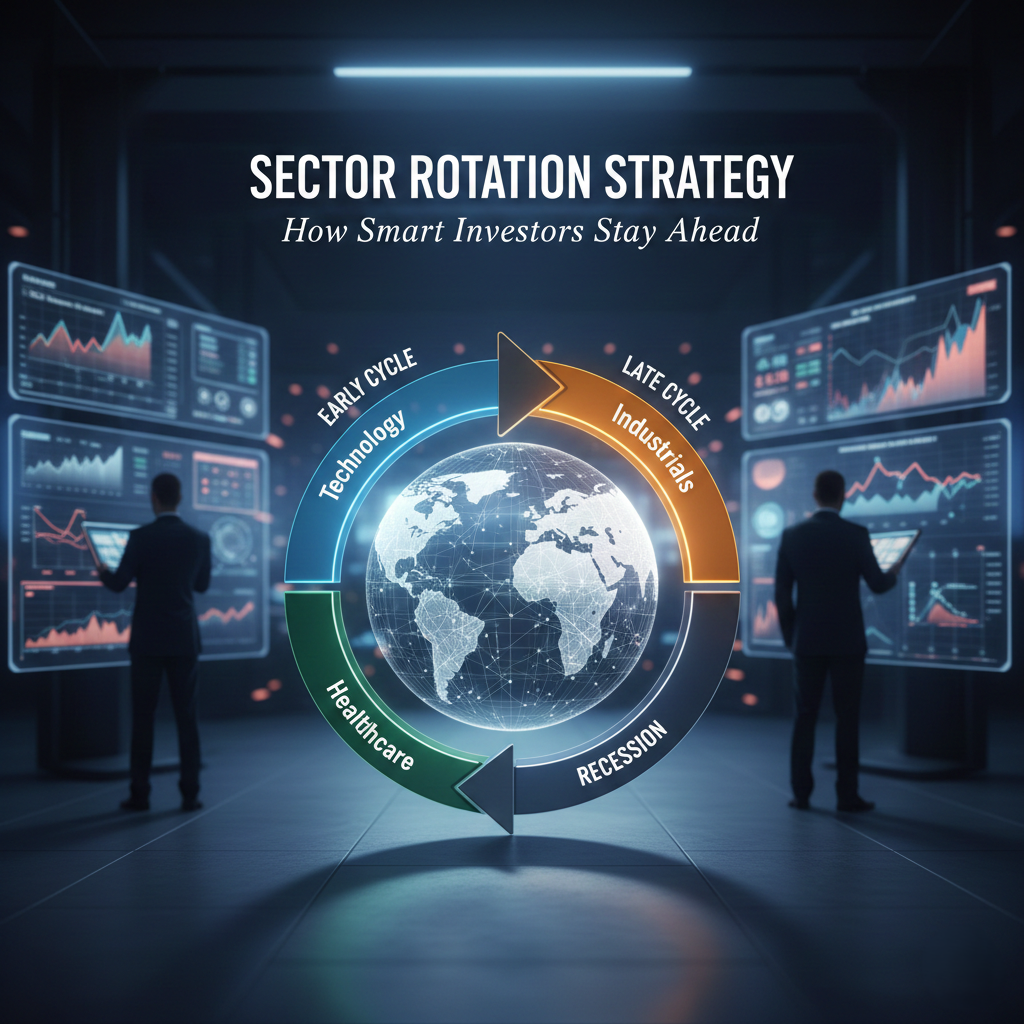
The Four Phases of the Economic Cycle and Which Sectors Outperform
1. Early Cycle: Recovery Begins
This phase follows a slowdown or recession. Growth picks up sharply, credit becomes more available, and confidence rises. People spend more, businesses invest again, and borrowing becomes easier.
Cyclical sectors tend to lead this stage. Tech, consumer discretionary, financial, and industrials usually get a strong boost as demand rebounds. Investors who position early often benefit the most, since prices tend to climb quickly once recovery starts.
2. Mid Cycle: Stable, Broad Growth
This is usually the longest and most steady part of the cycle. Growth remains healthy, corporate profits improve, and business expansion continues.
Sectors that led in the early cycle-tech, industrials, and consumer discretionary often continue performing well. Investors typically hold onto their cyclical positions while slowly building exposure to value-oriented sectors. It’s a phase where maintaining growth exposure generally works.
3. Late Cycle: Growth Slows, Caution Rises
In the late cycle, growth peaks and starts to cool. Inflation picks up, resources get stretched, and central banks raise interest rates to prevent overheating.
Cyclical sectors begin to lose steam. Higher interest rates especially hurt tech and consumer discretionary companies. This is when investors start shifting toward defensive areas like healthcare, utilities, and consumer staples. Energy may also benefit when inflation lifts commodity prices.
4. Recession: Defensive Sectors Take the Lead
During recessions, economic activity contracts. Profits fall, unemployment rises, and consumers cut back.
Defensive sectors hold up best in this environment. Healthcare, utilities, and consumer staples tend to maintain stable demand. Precious metals can also attract investors looking for safety. Those who moved to defensive sectors in advance usually see far smaller declines than those who stayed in cyclical areas.
Key Indicators That Signal Sector Rotations
Smart investors don’t rely on guesswork. They watch a few important indicators that reveal where the economy is heading.
GDP Growth
Strong GDP growth usually supports cyclical sectors. Slowing or negative GDP often signals it’s time to shift toward defensive areas.
Interest Rates
Falling rates encourage spending and help growth sectors. Rising rates tighten conditions and typically favor defensive sectors over tech and discretionary stocks.
Inflation
Moderate inflation supports cyclical sectors. High inflation often boosts energy and materials companies.
Employment Data
Low unemployment strengthens consumer spending, which lifts discretionary sectors. Rising unemployment signals weaker spending ahead and supports defensive sectors.
Corporate Earnings
Improving earnings support expansions. Falling earnings often signal approaching slowdowns and justify rotating toward safer sectors.
Cyclical Sectors: Leaders During Expansions
Cyclical sectors move closely with economic growth. They perform well in good times and fall harder in downturns.
Technology thrives when businesses and consumers spend more on innovation and devices.
Consumer Discretionary benefits from strong spending.
Industrials gain from increased construction, manufacturing, and expansion.
Financials grow when lending activity rises, and interest rate conditions are favorable.
Materials benefit from demand for raw materials during expansions.
Defensive Sectors: Stability in Slowdowns
Defensive sectors are less sensitive to economic cycles. Their products and services stay in demand even during recessions.
Healthcare offers essential services.
Consumer Staples provide food and necessities.
Utilities supply power and essential infrastructure.
Telecommunications remains essential in every condition.
How to Put Sector Rotation Into Practice
1. Track Economic Indicators Regularly
Set up a simple routine each month. Review GDP, interest rate updates, inflation, employment data, and earnings trends. Most information is freely available from government and financial websites.
2. Identify the Current Phase of the Cycle
Look at whether the data is improving or weakening. You don’t need perfect accuracy-just a reasonable view of direction.
3. Adjust Your Portfolio Based on the Cycle
Increase cyclical exposure during early and mid-cycle phases. Shift toward defensive sectors during late-cycle and recession periods.
4. Use Sector ETFs for Easy Rotation
Sector ETFs make rotation simpler. They provide diversification, lower risk compared to single stocks, and easier entry and exit.
5. Review Your Allocations Regularly
Check your sector positions quarterly or whenever major economic data changes. Adjust as needed instead of reacting emotionally.
Real Examples of Sector Rotation in Action
After the 2008 Crisis
Recovery in 2009–2010 led investors back into cyclical sectors. Tech, industrial, and discretionary stocks surged.
Pandemic and Reopening (2020–2021)
At the start of COVID-19, money moved into defensive sectors and tech. When economies reopened, investors rotated heavily into energy, financials, and travel-related stocks.
High-Inflation Period of 2022
Rising inflation pushed money toward energy, value stocks, and defensive sectors, while tech struggled.
Common Pitfalls in Sector Rotation
1. Getting the Timing Wrong
Predicting market shifts precisely is difficult. Many investors enter too late or exit too early. Even perfect timing doesn’t always produce huge gains.
2. Following Trends Instead of Indicators
Chasing hot sectors after they’ve peaked is a common mistake. Discipline and data matter more than crowd behavior.
3. Ignoring Costs and Taxes
Frequent trading increases brokerage fees and tax liabilities, especially for short-term gains.
4. Allowing Concentration Risk
Putting too much money into one or two sectors increases risk if the rotation doesn’t work.
5. Underestimating Unexpected Events
Shocks like pandemics or geopolitical tensions can disrupt the cycle. Flexibility is important.
Why Sector Rotation Isn’t Easy for Everyone
Successful rotation requires identifying the right sectors, choosing the right stocks or ETFs, and exiting at the right time. Many investors don’t have the time or discipline to monitor economic data regularly. On top of that, taxes and transaction costs often reduce the benefit of frequent shifts.
A Balanced Way to Use Sector Rotation
A practical approach is to combine a stable core portfolio with a smaller tactical portion for rotation.
- Keep a core allocation across all sectors for diversification.
- Rotate part of your portfolio based on economic indicators.
- Follow clear rules for when to shift sectors.
- Limit trading frequency to control costs and taxes.
Key Takeaways
• The economic cycle influences which sectors outperform.
• Tracking indicators like GDP, inflation, and interest rates helps guide rotations.
• Sector ETFs make rotation simple and diversified.
• Costs and taxes matter more than many investors realize.
• A diversified core portfolio protects against mistakes.
• Consistency and discipline are essential.
• No strategy will time the market perfectly, and that’s normal.
Conclusion: A Practical Strategy for Long-Term Investors
Sector rotation is a useful strategy for anyone who wants to stay aligned with economic trends. By understanding how cycles work, monitoring key indicators, and adjusting gradually, investors can improve returns and reduce unnecessary risk. It’s not about predicting the future perfectly but about responding to changes with a clear plan.
With a mix of discipline, patience, and realistic expectations, sector rotation can help you keep your portfolio better positioned through every phase of the market. Start by tracking the major indicators, build a simple rotation framework, and adjust slowly as conditions change. Over time, this thoughtful approach can lead to more consistent performance and stronger long-term results.

Leave a Reply