

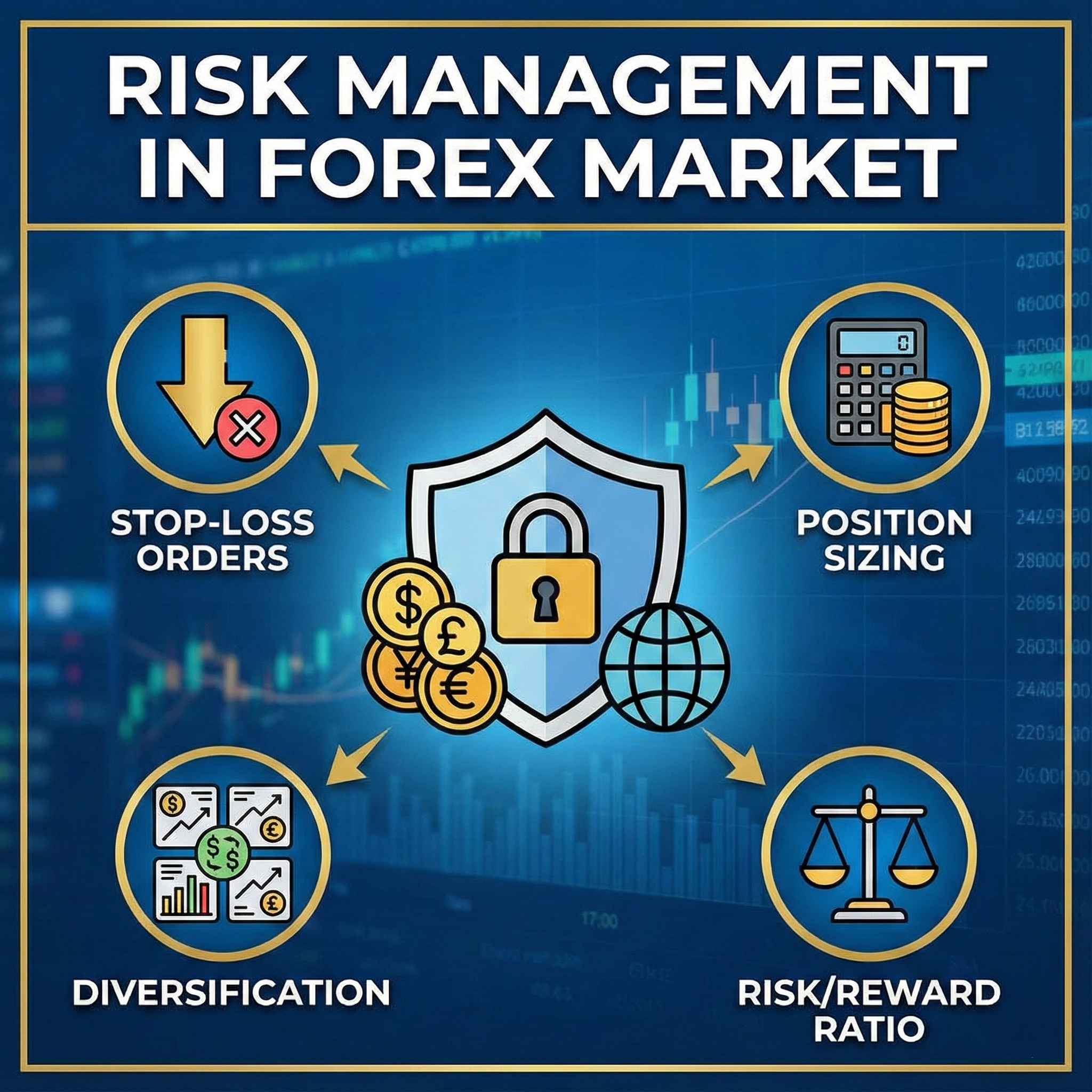
Why Risk Management Sits at the Center of Successful Forex Trading
Risk management forms the base of every sustainable trading approach. Many traders enter the forex market with excitement, yet they often overlook the one skill that protects their capital. Since forex prices shift quickly and markets remain open almost all week, traders need a strong plan to survive constant volatility. When you control your downside, you give your wins room to grow. Without that structure, even a good strategy collapses under pressure.
Why the Forex Market Demands Disciplined Protection
The forex market never rests while it’s open. It moves 24 hours a day, five days a week. This pace gives traders endless opportunities, but it also exposes them to unexpected risks. Central banks make surprise announcements, global events break suddenly, and economic data shifts market direction within seconds. Although these moments can create profit, they can also turn a strong trade into a painful loss if you enter without protection. For this reason, risk management is not optional. It works as the foundation that gives you stability in a constantly changing environment.
Why Strategy Alone Isn’t Enough
Many beginners spend months looking for the perfect indicator or strategy. Experienced traders, however, focus on managing risk long before they worry about entry patterns. Even the most accurate strategy fails when traders risk too much or freeze when a trade moves against them. Proper risk management keeps your losses small enough to survive bad days and sharp reversals. When you stay in the market long enough, your strategy has time to produce consistent results. Without a risk plan, emotional decisions take over, and fear or impatience ends up guiding every move.
The Difference Between Trading and Gambling
Trading without a framework turns the experience into guesswork. A gambler reacts to impulses and hopes for luck. A trader defines rules before taking action. They know how much they’re willing to lose, where they will exit, and which conditions allow them to enter. This structure provides clarity during fast movements, and it reduces panic when a trade doesn’t behave as expected. As a result, disciplined traders protect themselves from emotional swings that cause most account blowouts.
Facing the Reality of Market Uncertainty
No one can predict every movement in the forex market. Even traders with decades of experience cannot avoid losses. However, the difference lies in how they handle those losses. Traders who respect risk stay calm during losing streaks because they know the damage will be limited. Traders who ignore risk usually blow up their accounts before they get the chance to improve. This understanding explains why long-term traders focus less on how many trades they win and more on how effectively they manage the downside.
How Risk Management Builds Stability
A strong risk plan gives you the power to stay profitable even when your win rate isn’t high. When your losses stay small and your winners grow, consistency becomes easier to maintain. This stability matters even more during unpredictable market cycles. Moreover, when you already know your trade size, your maximum loss, and your exit points, you remove unnecessary stress from the process. Clarity makes it easier to follow your setup without second-guessing yourself.
The Psychological Benefits of Structured Protection
Risk management also helps shape your mindset. Each time you follow your rules, you strengthen your discipline. Over time, you stop relying on luck and start trusting your process. Your confidence grows because you know you can handle volatility without losing control. This steady mindset protects you from impulsive actions, revenge trading, and oversized positions that wipe out accounts.
Why Risk Management Keeps You in the Game
Every trader experiences ups and downs. Some months feel smooth, while others bring unexpected challenges. A solid risk plan makes sure you don’t lose everything during tough periods. Instead of stepping away in frustration, you stay prepared for the next opportunity. That ability to remain active in the market is one of your biggest advantages because growth in trading comes from experience, reflection, and time.
A Foundation for Long-Term Success
Risk management acts as the anchor that keeps you steady in a fast-moving market. It prevents small errors from becoming disasters and helps you treat trading as a long-term business, not a quick gamble. When you build structured habits early, you give yourself a strong chance to grow, remain consistent, and reach your financial goals without unnecessary setbacks.
The Six Primary Types of Forex Trading Risks You Must Understand
To manage risk effectively, you first need to understand the different types of dangers that exist in the forex market. Each risk category affects your trades in a different way, and each one requires a unique approach. Once you know these risks clearly, you can build strategies that protect your capital while giving you the confidence to trade in various market conditions.
Market Risk: The Most Obvious and Constant Threat
Market risk refers to the chance that price moves against your position. Because the forex market reacts to economic news, geopolitical tensions, and central bank decisions, prices can shift sharply even within seconds. Although you can’t eliminate this risk entirely, you can reduce its impact through proper trade sizing and disciplined stop-loss placement.
For instance, a sudden interest rate change or an unexpected political announcement can push a currency pair far beyond its usual price range. Therefore, traders must stay aware of key events and avoid taking oversized positions before major announcements. While market risk is unavoidable, managing it well keeps your losses small and your account stable.
Leverage Risk: The Hidden Danger That Amplifies Everything
Leverage attracts many traders because it allows them to control large positions with small amounts of money. However, the same leverage that multiplies profits also multiplies losses. Many accounts blow up not because of bad strategies, but because traders use too much leverage with too little protection.
Although brokers offer high leverage ratios, responsible traders avoid using them blindly. Instead, they adjust their leverage according to volatility and only take trades that fit their risk tolerance. When the market moves a few pips against a high-leverage position, the loss grows faster than many beginners expect. Because of this, smart traders treat leverage like a sharp tool-useful, but dangerous without caution.
Liquidity Risk: When the Market Becomes Hard to Enter or Exit
The forex market is highly liquid, especially with major pairs like EUR/USD or USD/JPY. Still, certain situations create liquidity problems. Exotic pairs, off-peak market hours, and major news releases can all trigger wider spreads and slippage. As a result, traders may struggle to enter or exit positions at their desired prices.
Although you can’t avoid liquidity risk entirely, you can manage it by sticking to highly traded pairs during normal sessions. You can also check economic calendars to avoid opening positions right before major announcements. This approach helps you maintain control over your executions while reducing unexpected losses due to sudden spread expansions.
Counterparty Risk: Trusting the Institution That Holds Your Money
Counterparty risk refers to the chance that your broker fails to meet its financial obligations. Although well-regulated brokers offer strong protection, not every broker operates under strict oversight. Because of this, choosing the right brokerage becomes a critical part of your overall risk plan.
Traders should check whether their broker is regulated by reputable authorities. They should also review how deposits are handled, whether client funds are kept separate from company funds, and what protections exist in case of insolvency. Although traders may overlook this factor, counterparty risk can cause major losses when ignored.
Interest Rate Risk: How Central Banks Affect Currency Values
Interest rate risk comes into play when you hold trades overnight. Since each currency has its own interest rate, brokers apply rollover fees or swap credits depending on the pair you hold. Moreover, central banks influence currency strength through interest rate changes. These decisions often cause large movements because interest rates determine how attractive a currency becomes for global investors.
Although this risk cannot be avoided completely, you can reduce it by tracking central bank calendars and understanding how interest rate expectations impact your chosen pairs. When you stay aware of these shifts, you can plan your trades more effectively and avoid unnecessary overnight exposures.
Psychological Risk: The Invisible Force Behind Bad Decisions
Psychological risk might be the most underestimated danger in forex trading. Fear, greed, impatience, and overconfidence routinely cause traders to break their own rules. When emotions take control, traders tend to chase losses, increase position sizes impulsively, or hold losing trades much longer than planned.
Although no trader can remove emotions entirely, you can train yourself to manage them. A solid risk management plan reduces emotional pressure by giving your trades structure. When you know your stop-loss, position size, and exit rules beforehand, decision-making becomes easier. With consistent practice, your emotions stop affecting your results as much.
Why Understanding These Risks Matters
Each of these six risks plays a major role in your long-term performance. When you can identify them clearly, you can build strategies that protect your capital from sudden changes, unexpected events, and emotional impulses. Although risk cannot be eliminated, it can be controlled with discipline and knowledge. As you learn to manage each type of risk, you strengthen your ability to survive difficult periods and capitalize on strong market conditions.
Stop-Loss Orders: Your First Layer of Protection
A stop-loss order closes your position automatically when the market moves against you by a set amount. Without stop-losses, losses can grow out of control, especially during fast or unpredictable movements. Although it might feel uncomfortable to lock in a loss, using stop-loss orders consistently saves your account from catastrophic declines.
Static Stop-Losses
A static stop-loss uses a fixed pip distance. For example, you may decide to risk 50 pips on each trade. Although this method is simple, it doesn’t always consider market structure. Different pairs have different volatility levels, so a fixed approach may work well in some situations but poorly in others.
Technical Stop-Losses
A technical stop-loss sits below support levels for long positions or above resistance levels for short positions. Because these levels reflect actual market structure, your trade gets enough room to breathe. You also avoid getting stopped out by minor noise.
Trailing Stop-Losses
A trailing stop moves with the market as your trade becomes profitable. Since it locks in gains while still giving your trade space, it works well for trending markets. Trailing stops protect profits without forcing you to exit too early.
Why Stop-Loss Discipline Matters
Many traders lose money because they move their stop-loss farther away when the market moves against them. This mistake turns a manageable loss into a damaging one. When you follow your stop-loss rules, you limit losses and preserve emotional balance.
Leverage: A Powerful Tool That Demands Respect
Leverage multiplies both profits and losses. Although high leverage looks attractive, it can destroy an account if used without caution. Because small price movements become magnified, your margin level can fall quickly and trigger a margin call.
Responsible Leverage Use
Professional traders often use leverage ratios like 1:10 or 1:20 rather than the extremely high ratios offered by brokers. This approach gives trades enough breathing room while keeping risk under control.
Margin Calls and Forced Liquidation
When your account balance falls below the required margin level, your broker may restrict new trades. If your margin level keeps falling, the broker can close your trades automatically. Although this protects the broker, it often happens at the worst possible time for the trader.
Adjusting Leverage for Volatility
During volatile events, even small positions can experience large swings. Because of that, reducing leverage during high-impact news helps protect your account from rapid drawdowns.
The Risk-to-Reward Ratio: Why Every Trade Must Justify Its Risk
The risk-to-reward ratio compares your potential loss to your potential gain. A balanced ratio ensures that your winners outweigh your losers over time, even if your win rate isn’t high.
The Minimum Standard: 1:2
Many traders aim for a ratio of at least 1:2. If you risk $100, your potential reward should be $200. This structure gives you room to maintain profitability even with a modest win rate.
A Practical Example
Imagine taking ten trades and risking $100 each time. If you win four trades and make $200 on each winner, you gain $800. If you lose six trades, you lose $600. Although your win rate is only 40%, you still walk away with a net profit because your winners paid more than your losers cost.
Why RRR Creates Confidence
A strong risk-to-reward ratio reduces pressure to chase trades. You don’t need to win every trade to grow. You only need to follow your rules consistently.
Hedging Strategies: Reducing Exposure During Uncertain Conditions
Hedging protects your positions during unpredictable market conditions. Although not all traders use hedging, it can be valuable when volatility becomes intense.
Direct Hedging
Direct hedging involves opening a long and short position on the same currency pair. While this eliminates directional exposure, it also freezes your profit potential until you close one side. Because of this, traders usually reserve direct hedging for major announcements or sudden shifts in sentiment.
Correlation Hedging (Pairs Trading)
Some currency pairs move together because of shared economic influences. For example, EUR/USD and GBP/USD often show positive correlation. When their relationship stretches beyond normal levels, traders can open offsetting positions to profit when they return to balance. Although this method requires skill, it offers strong protection against market-wide movement.
Why Hedging Supports Stability
Hedging helps you stay protected during uncertain conditions. Although it doesn’t eliminate all risks, it reduces the impact of sudden movements and gives you time to evaluate your next steps.
Diversification: Spreading Risk Across Multiple Opportunities
Diversification prevents you from relying too heavily on one currency pair or one strategy. When you spread your exposure, you reduce the chance of suffering consecutive losses from correlated movements.
Diversifying Across Currency Pairs
Major pairs usually behave differently under various economic conditions. Trading more than one pair allows you to balance risk. However, you must monitor correlations to avoid unintended overlap. For example, going long EUR/USD and GBP/USD at the same time often means taking two similar trades.
Diversifying Across Strategies
Using more than one style-such as trend-following and countertrend approaches-helps you adapt to different market environments. Markets shift between trending, ranging, and volatile phases, so having multiple strategies gives you flexibility.
Why Diversification Strengthens Account Stability
When one pair experiences a losing streak, another pair or strategy may perform well. This balance protects your account from large drawdowns and keeps your trading journey steady.
Monitoring Your Margin Level: Staying Clear of Margin Calls
Margin plays a central role in forex trading. It represents the amount of capital you need to open and hold positions. Although it gives you the ability to control larger trades, it also exposes you to the danger of margin calls when used carelessly.
Understanding Margin Level
Your margin level shows how much equity you have relative to the margin used. The formula is simple:
Margin Level = (Equity ÷ Used Margin) × 100
When your margin level is high, your account is healthy and When it falls too low, you risk forced liquidation.
When Margin Calls Become a Threat
Most brokers issue a warning when your margin level reaches 100%. At that point, you can no longer open new trades. If the level continues to drop-often near 50% or lower-the broker may close your positions automatically. Because this can happen during high volatility, traders often face losses far larger than expected.
How to Stay Safe
To prevent margin calls:
- Keep your margin usage well below 50%
- Use lower leverage during uncertain conditions
- Close or reduce positions when volatility spikes
- Track your equity regularly, especially during active trades
A healthy margin level gives your trades enough room to move while protecting your account from sudden liquidation.
The Psychological Component: Managing Emotions and Building Mental Discipline
Trading is as much a mental skill as it is a technical one. Even the most accurate strategy fails when emotions take control. Therefore, developing emotional discipline becomes one of your most important responsibilities as a trader.
Fear: The Emotion That Holds You Back
Fear often appears after a losing streak. It pushes you to avoid good setups because you worry about another loss. Although caution is important, too much fear prevents you from following your strategy.
Greed: The Emotion That Makes You Overreach
Greed often follows winning streaks. Traders begin increasing lot sizes, skipping stop-losses, or chasing trades that don’t fit their plan. These impulses turn good momentum into unnecessary losses.
Overconfidence: The Silent Risk
After several wins, many traders believe they can’t lose. This mindset leads to oversized positions, ignored rules, and dangerous risks. Overconfidence often causes the biggest losses.
Regret and Revenge Trading
Regret appears when traders exit too early or too late. This emotion pushes them into revenge trading, where they try to recover losses quickly. Because these trades lack planning, they usually make the situation worse.
How to Control These Emotions
To manage psychological risk:
- Follow your trading plan strictly
- Use predetermined stop-loss and take-profit levels
- Stick to your position sizing formula
- Take breaks after big losses or big wins
- Review your trades regularly
When you rely on rules instead of emotions, your decisions become clearer and more consistent.
The Power of a Trading Journal: Learning From Every Experience
A trading journal is one of the simplest yet most effective tools for improvement. Many traders skip this step, thinking they don’t need it. However, a journal gives you insights that no indicator or expert can provide.
What Your Journal Should Include
Record details such as:
- Entry and exit prices
- Position size
- Stop-loss and take-profit levels
- Market conditions
- Reason for entering the trade
- Emotional state during the trade
- Outcome and what you learned
Why a Journal Strengthens Your Growth
Reviewing your journal helps you identify patterns. You may notice you often lose in a specific market condition or that you exit winners too early. These patterns reveal weaknesses you can fix.
Although this process takes time, it builds experience faster than trading randomly. Over time, your journal becomes a roadmap for better performance and stronger discipline.
Common Forex Trading Mistakes That Destroy Accounts
Many traders lose money because they repeat avoidable mistakes. Recognizing these errors early helps you protect your account and stay consistent over the long term.
Trading Without a Plan
Entering trades without rules turns every decision into guesswork. Traders with no plan often act on impulses, which leads to emotional exits and poor judgment.
Overleveraging
Using too much leverage magnifies every small price movement. One bad trade becomes catastrophic. Responsible traders limit leverage and prioritize capital protection.
Ignoring Stop-Loss Orders
Some traders move or delete stop-losses, hoping the market will turn around. This habit can wipe out accounts quickly, especially during strong trends.
Averaging Down
Adding to losing positions often feels like a strategy, but it increases risk dramatically. If your original analysis was wrong, the larger position multiplies losses.
Revenge Trading
Trying to win back losses immediately leads to oversized positions and poor decisions. This cycle often accelerates account destruction.
Overtrading
Taking too many trades-especially during emotional moments-exhausts your focus and reduces your accuracy. Quality matters more than quantity.
Building Your Personal Risk Management System
Although every trader follows similar principles, your personal system must match your goals, risk tolerance, and trading style. A strong system doesn’t restrict you; it supports you.
Key Elements to Include
Your system should include:
- A maximum risk per trade (1–2%)
- A standard position sizing formula
- Defined entry and exit rules
- A minimum risk-to-reward ratio
- Specific leverage guidelines
- Maximum margin usage limits
- A journaling routine
- Rules for avoiding trading during extreme volatility
Reviewing and Updating Your System
As you gain experience, your system will evolve. Reviewing it every quarter helps you refine weak areas and adjust for new market conditions. Because the forex market constantly changes, your system must stay adaptable.
Conclusion: Your Path to Sustainable Forex Trading Success
Risk management determines long-term success far more than any trading strategy, indicator, or signal. When you control your risk, you protect the most important resource you have-your capital. Without capital, no strategy matters. With proper protection, even simple strategies can produce consistent results.
Although the market moves with speed and uncertainty, disciplined traders stay grounded because they trust their process.
They limit losses.
They size positions carefully.
They use stop-losses without hesitation.
They avoid emotional decisions.
They learn from every trade.
They treat trading as a long-term journey, not a quick gamble.
When you master risk management, you give yourself the opportunity to grow steadily and confidently. You stay in the game long enough to benefit from compounding gains, and you avoid the pitfalls that remove many traders from the market too early.
By respecting the risk that comes with forex trading, you turn uncertainty into opportunity and transform trading from guesswork into a structured, sustainable business.

Leave a Reply