

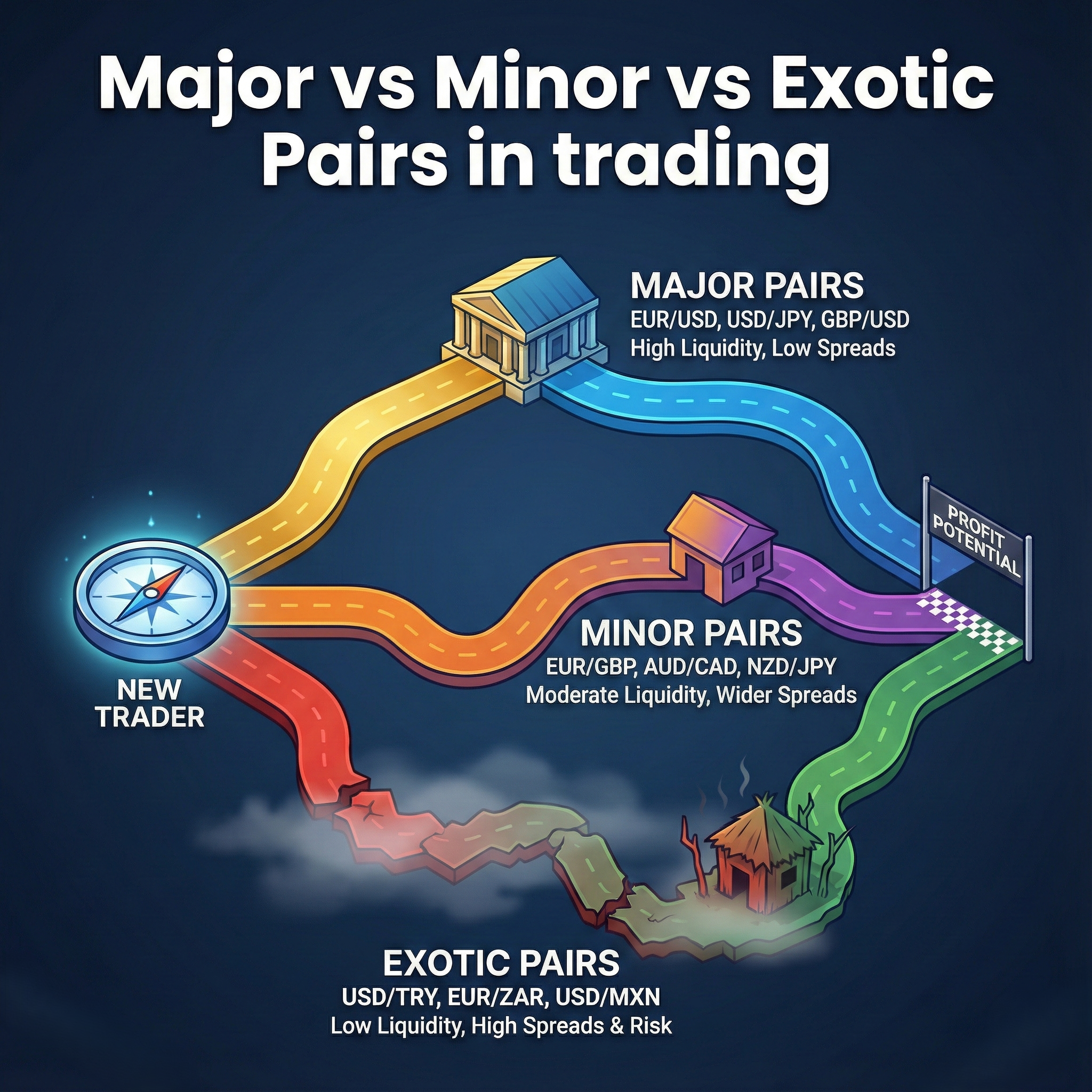
Starting your forex journey feels exciting, but the huge list of currency pairs can confuse anyone. You open your platform and suddenly see dozens of combinations moving in different directions. At first, it seems like every pair offers a new opportunity. Later, you realize that choosing the right pair matters as much as choosing a good strategy. The truth is simple: pair selection shapes your trading results through liquidity, volatility, spreads, and how easily you can manage risk. When you understand how major, minor, and exotic pairs behave, you give yourself a much smoother start.
Understanding the Basics: What a Currency Pair Actually Represents
Every forex quote displays two currencies paired together. The first is the base currency, and the second is the quote currency. For example, in EUR/USD, the euro sits on the left as the base, while the US dollar sits on the right as the quote. The displayed price tells you how much of the quote currency you need to buy one unit of the base.
Imagine EUR/USD trading at 1.16. This means you need 1.16 dollars to buy one euro. Once you understand this structure, price movements start making more sense. Even a one-pip movement affects your profit or loss depending on your position size. Moreover, news from either currency’s economy can push the pair up or down, so knowing the structure helps you read the market faster.
Although this seems basic, many beginners skip it and jump straight into charts. As a result, they misinterpret movements and get confused when their stop-loss triggers earlier than expected. A strong grasp of how pairs work becomes your foundation before exploring advanced concepts.
Major Currency Pairs: The Best Starting Point for New Traders
What Makes a Pair “Major”?
Major currency pairs involve the US dollar paired with another globally important currency. These seven pairs dominate daily trading volume and attract huge participation from banks, institutions, hedge funds, and retail traders. The major pairs are:
- EUR/USD
- GBP/USD
- USD/JPY
- USD/CHF
- AUD/USD
- USD/CAD
- NZD/USD
Each pair behaves differently because each reflects a unique economic relationship. EUR/USD reacts strongly to decisions from the European Central Bank and the Federal Reserve. USD/JPY often moves when traders seek a safe asset during uncertainty. GBP/USD responds sharply to political shifts in the United Kingdom. Since millions of traders monitor these pairs, you gain access to predictable patterns and cleaner price action.
Why Beginners Should Start With Major Pairs
New traders benefit from major pairs because they provide a smoother learning curve. First, these pairs offer the highest liquidity in the market. High liquidity means you can enter and exit trades immediately without worrying about big price jumps between your order and your fill. It also means spreads stay tight, so your trading costs remain low.
Additionally, major pairs move with moderate volatility. This gives you enough movement to take profit while avoiding extreme swings that can wipe out accounts. Because these currencies belong to established economies, their price behavior follows clear patterns. Trends, pullbacks, and breakouts appear more consistently, and you can practice technical analysis with confidence.
Another major advantage is the abundance of information. Every central bank speech, inflation report, and economic release is tracked by analysts worldwide. You don’t have to dig through complex data to understand why EUR/USD is moving. Clear news coverage means you learn faster, react smarter, and build stronger trading habits.
Key Characteristics of Major Pairs
1. High Liquidity
Liquidity is the biggest strength of major pairs. Since so many traders participate, buying and selling happen instantly. During active sessions, you often see spreads of just one or two pips, especially in EUR/USD. Tight spreads help you keep more of your profit, since less of it goes toward trading costs.
2. Predictable Behavior
Although the market will always surprise you, major pairs tend to follow logical patterns because large institutions dominate the order flow. When the Federal Reserve hints at higher interest rates, USD pairs usually strengthen. When economic numbers miss expectations, many pairs respond quickly and cleanly. Predictability helps you learn faster and refine your strategy.
3. Moderate Volatility
Major pairs usually move steadily. They rarely produce the wild swings that appear in exotic markets. This allows beginners to practice setting reasonable stop-loss levels and managing their risk without facing sudden, extreme price spikes.
How Major Pairs Help You Build Skill
You learn trading much faster when your charts behave cleanly. Major pairs often respect support and resistance levels. Moving averages align smoother. Trendlines hold longer. Because the price action isn’t distorted by huge spreads or illiquidity, your technical skills develop naturally. Many traders who start with exotic pairs quit early because they think they are bad at trading, when in reality the pair was simply too unpredictable.
As you grow more comfortable with major pairs, you learn how to time entries during active sessions, understand how news releases impact price, and feel how momentum builds and fades. Over time, this experience becomes the foundation that supports your progress toward more complex markets.
When Major Pairs Might Not Be Ideal
Although major pairs work best for beginners, certain conditions make them less attractive temporarily. For example, during long periods of consolidation, EUR/USD can remain stuck in tight ranges for weeks. Trend traders may struggle to find clean moves. Additionally, heavy news cycles can create sudden bursts of volatility that confuse beginners. Even so, major pairs remain the safest, most structured environment to learn in.
Minor Currency Pairs: Your Next Step After Mastering the Majors
Once you gain confidence with major pairs, you may want fresh opportunities or sharper movements. Minor currency pairs offer both. These pairs combine two strong global currencies but leave out the US dollar. Because they still come from developed economies, they remain more stable than exotic pairs while giving you different price behavior. As a result, minor pairs act as the natural “next level” for traders who want more movement without entering high-risk territory.
What Counts as a Minor Currency Pair?
A minor pair, also called a cross pair, includes major currencies like EUR, GBP, JPY, CHF, AUD, or CAD, but excludes USD. Common examples include:
- EUR/GBP
- EUR/JPY
- GBP/JPY
- EUR/CHF
- AUD/JPY
- GBP/CHF
Although these pairs trade less than majors, they still generate billions in daily volume. That makes them active enough for real trading, yet different enough to require a stronger understanding of price behavior.
Minor pairs also reflect regional economic relationships. EUR/GBP moves when European and British markets shift independently of the US dollar. GBP/JPY reacts to both British financial news and Japanese risk sentiment. Because of these unique influences, minor pairs help you diversify your trading ideas.
How Minor Pairs Differ From Major Pairs
Minor pairs behave differently in several important ways. When you understand these differences early, you avoid costly mistakes.
1. Liquidity Drops Slightly
Although minor pairs offer solid liquidity, they can’t match the depth and speed of majors. You may see spreads expand during slower hours. You might also notice slightly slower execution when the market becomes thin. Fortunately, these differences remain manageable for most strategies.
2. Spreads Increase
Since fewer traders participate, spreads widen compared to major pairs. EUR/GBP might show a spread of 2–4 pips during active hours, compared to a single pip for EUR/USD. These extra costs add up, so you must adjust your expectations. You need slightly larger moves to produce the same profit.
3. Volatility Often Rises
Many minor pairs move more sharply than majors. GBP/JPY, for example, is famous for large swings throughout the day. These swings create excellent opportunities for skilled traders. However, they also introduce more risk for beginners. Once you develop proper risk control, this volatility becomes an advantage.
4. Correlations Change
Because minor pairs exclude the US dollar, they move differently from the pairs you learned first. EUR/GBP reacts to local factors like European political developments or the Bank of England’s decisions. EUR/JPY responds heavily to risk sentiment in the Asian markets. These unique correlations help you build a more balanced trading portfolio.
When Should You Begin Trading Minor Pairs?
Most new traders should stick with major pairs for at least three to six months. During this time, you build chart-reading skills, emotional discipline, and risk management habits. Once you see consistent results and feel comfortable analyzing market conditions, minor pairs become a natural progression.
Traders often shift to minor pairs for one of these reasons:
1. You Want Less Exposure to USD Volatility
During major US economic releases like NFP or CPI, all USD pairs may move violently. If you want calmer reactions or smaller swings, minor pairs can protect you from excessive turbulence.
2. You See a Strong Regional Trend
Sometimes Europe strengthens while the UK weakens. Sometimes Japan becomes the global safe-haven currency. Minor pairs let you trade these regional stories directly without involving USD.
3. You Want More Trading Setups
Major pairs occasionally go quiet. When EUR/USD ranges tightly or USD/JPY pauses before news, minor pairs may still offer clean patterns and breakouts. They help you expand your opportunities without taking extreme risks.
Characteristics of Minor Pairs You Must Understand
1. Moderate Liquidity
Liquidity remains acceptable for most trading styles, though scalpers should approach with caution. Swing traders usually face no issues. Because the market doesn’t match major pair volume, expect occasional slippage during off-hours.
2. Wider Spreads
Although spreads stay manageable, they cut deeper into your profits over time. You must plan your entries more carefully. Strategies that work with major pairs may need adjustments here.
3. Higher Volatility
The extra volatility creates both opportunity and danger. You can catch stronger moves, but those moves can reverse quickly. Because of this, stop-loss placement becomes more important. Many traders use smaller positions on minor pairs to control risk.
4. Unique Regional Behavior
Minor pairs often react to local events such as central bank speeches, political changes, or region-specific economic data. EUR/GBP, for example, reacts heavily to Brexit-related developments and economic divergence between the UK and Eurozone. Understanding these dynamics gives you an edge.
Why Many Traders Love Minor Pairs
Minor pairs bring variety and potential. Once you feel limited by the predictable nature of major pairs, minor pairs challenge you with new types of movement. They help you grow as a trader because you learn how currency relationships differ outside USD-driven flows.
Furthermore, minor pairs often trend cleanly when global markets become uncertain. When USD becomes unpredictable due to government policy changes or interest rate speculation, minor pairs may continue forming stable patterns. That makes them a valuable tool for diversification.
When Minor Pairs Become Difficult
Despite their benefits, minor pairs can frustrate unprepared traders. Sudden spikes, inconsistent reactions to news, and temporary liquidity gaps can shake your confidence. Because the spreads cost more, every mistake becomes slightly more expensive. When you overtrade a pair like GBP/JPY, the volatility can drain your account faster than you expect.
Still, these challenges remain manageable once you apply disciplined risk management. With patience and consistency, traders often find minor pairs rewarding.
Exotic Currency Pairs: High Risk, High Reward, and Not for Beginners
Eventually, every trader becomes curious about exotic pairs. They look attractive because the candles move fast, the ranges look huge, and the potential profit seems impressive. However, these pairs often expose traders to risks they never expected. Exotic pairs combine one major currency with a currency from a developing or emerging economy. Because these economies behave differently from developed ones, their currencies move in unpredictable and sometimes violent ways.
Examples include:
- USD/TRY (US dollar / Turkish lira)
- USD/ZAR (US dollar / South African rand)
- EUR/TRY (euro / Turkish lira)
- USD/SGD (US dollar / Singapore dollar)
Although they appear exciting, they demand far more skill, patience, and experience than beginners usually have.
What Defines an Exotic Pair?
Exotic pairs come from countries with smaller financial markets, less stable politics, or inconsistent economic growth. These markets attract fewer institutional traders, so fewer orders move through them. As a result, exotic pairs behave differently from majors and minors.
Emerging markets often respond sharply to political events, government decisions, interest rate changes, or sudden economic disruptions. A single headline can move an exotic pair more in one hour than EUR/USD sometimes moves all day. Because of this, exotic pairs remain the most challenging category in forex.
Key Characteristics of Exotic Pairs
1. Very Low Liquidity
This is the biggest challenge you face with exotic pairs. Since fewer buyers and sellers participate, the market cannot absorb large orders smoothly. When liquidity drops, price jumps from level to level instead of moving gradually. You may plan an entry at a certain price, but the actual fill may appear far above or below your expectation.
2. Extremely Wide Spreads
Spreads for exotic pairs can reach 50, 100, or even 200 pips during slower sessions. Even during active market hours, spreads remain much wider than the spreads of major or minor pairs. Because of this, every trade costs more. You need a much larger price movement just to reach breakeven. Traders often underestimate these costs and realize too late that their strategy cannot handle the spread.
3. Violent Volatility
Exotic pairs move fast. A 300–500 pip daily range is not unusual. Because prices react to political news and unstable economic conditions, the market can turn sharply without warning. Even strong technical setups may fail instantly if a government releases a sudden policy announcement or faces unexpected instability.
4. High Political and Economic Risk
Countries behind exotic currencies often deal with inflation, unstable leadership, or economic uncertainty. These factors push their currencies into unpredictable cycles. A decision by a central bank can weaken or strengthen the currency within minutes. This environment makes exotic trading dangerous for anyone without deep knowledge of that region’s economy.
The Risk–Reward Equation in Exotic Pairs
Many traders believe exotic pairs offer bigger profits. Technically, this is true. When the pair trends, it can move hundreds of pips in your favor. However, the risk often outweighs the reward.
For instance:
- A profitable move might be 300 pips.
- A spread alone might cost 80 pips.
- A reversal might take 200 pips in minutes.
Because of this, the math becomes unfavorable. Your win rate needs to be extremely high, or your strategy needs exceptional precision. Most beginners cannot meet these demands.
Another issue involves leverage. Brokers often tempt traders with high leverage on exotic pairs. Many traders take oversized positions, hoping to earn big quickly. But once volatility hits, these positions blow up accounts faster than expected. This trap destroys more beginner accounts than any other factor.
Why New Traders Should Avoid Exotic Pairs
Most new traders lack the experience required to manage sudden volatility spikes. They also struggle with the emotional stress that exotic pairs create. Fear, panic, and impatience appear quickly when candles jump unpredictably.
You should avoid exotic pairs if:
- Your account is still small
- You aren’t consistent with major pairs
- You haven’t mastered stop-loss discipline
- You panic during fast market moves
- You still rely heavily on tight spreads
Furthermore, exotic pairs demand deep fundamental knowledge. You need to understand political risk, inflation cycles, and regional economic issues. Without this understanding, you trade blindly.
Even professional traders approach exotic pairs cautiously. They usually use smaller positions, wider stop-losses, and require strong confirmation before entering.
Where Exotic Pairs Fit in a Trading Journey
These pairs should come last in your learning sequence. Major pairs teach you discipline. Minor pairs teach you how markets behave without USD influence. Exotic pairs teach you how unpredictable the currency market can become. You must build strong chart-reading skills, emotional stability, and consistent profitability before considering them.
If you ever begin trading exotic pairs, start with:
- Very small position sizes
- Wider stop-losses
- Lower leverage
- Strict risk rules
- A deep understanding of the country’s economy
Exotics can be rewarding, but only after years of experience.
A Realistic View on Exotic Trading
Many traders dream of mastering exotic pairs because they believe the bigger moves mean bigger gains. In reality, exotic markets punish lack of discipline. They punish impatience. They punish overconfidence. They reward only traders who treat risk seriously and understand volatility at a deep level.
Although beginners often feel tempted, they should stay far away until they prove themselves with majors and minors. Once your foundation is strong, exotic pairs become an optional addition to your portfolio-not a necessity.
Liquidity: The Hidden Force That Shapes Every Trade
If you want to understand why some pairs feel easy and others feel chaotic, you must understand liquidity. Liquidity measures how quickly a market can fill orders without large price changes. When liquidity stays high, trades execute smoothly. When it drops, price jumps, spreads widen, and slippage increases.
Major pairs offer excellent liquidity because banks, institutions, and traders participate constantly. You feel this advantage every time your order fills instantly at the price you expected. Minor pairs still provide workable liquidity, though you may notice slightly larger spreads. Exotic pairs, however, often expose you to liquidity gaps that create unexpected results.
How Liquidity Affects Your Trading
1. Execution Quality Improves With Higher Liquidity
When a pair has high liquidity, your buy or sell order gets matched fast. You don’t pay extra. You don’t wait. You don’t suffer delays during volatile moments. This smooth execution helps new traders stay calm and confident.
2. Slippage Increases During Low-Liquidity Conditions
When liquidity drops, your order may fill at a worse price than expected. This problem hits exotic pairs most. A simple market order can slip dozens of pips during slow sessions. Even minor pairs can show slippage once major markets close.
3. Costs Rise When Liquidity Falls
Low liquidity usually comes with wide spreads. Because fewer traders participate, brokers cannot keep spreads tight. For new traders, wider spreads mean higher costs, lower profit potential, and more pressure to choose good setups.
Spreads: Your Silent, Constant Trading Cost
Every trade begins with a cost: the spread. The spread is the difference between the bid and ask price. You pay this cost instantly when you open a position. Because of that, spreads directly influence your strategy.
Major pairs have tight spreads due to heavy trading activity. EUR/USD or USD/JPY often show spreads of one or two pips. Minor pairs widen slightly, usually between two and five pips. Exotic pairs can show massive spreads, especially during low-volume hours.
Why Spreads Matter More Than You Think
1. Spreads Decide Your Breakeven Point
If the spread is 2 pips, you need 2 pips of profit to break even. When a spread hits 80 pips, you must recover all 80 pips before seeing a single cent of profit. This difference becomes painful in exotic trading.
2. Strategy Performance Changes With Spread Size
A strategy that works beautifully on EUR/USD may fail instantly on USD/TRY. The spread alone destroys profitability. Scalpers especially struggle because they rely on small price movements. This is why new traders should avoid exotic pairs until they have strong discipline.
3. Spreads Expand During Volatile Events
Even major pairs widen temporarily around major economic news. However, those expansions stay small compared to exotic pairs. Exotic spreads can explode during uncertainty, turning any trade into a bad one.
Volatility: Choosing the Right Level for Your Skill
Volatility shows how much a pair moves. Some pairs move calmly, while others swing aggressively. Understanding volatility helps you choose pairs that match your personality and trading style.
1. Major Pairs → Moderate, Steady Volatility
Major pairs usually move in controlled ranges. They follow logical patterns based on economic data and central bank actions. This helps beginners practice without encountering extreme price shocks.
2. Minor Pairs → Higher Volatility With More Opportunity
Minor pairs bring stronger swings. They create larger trends and bigger intraday moves. Because of that, skilled traders find them attractive. The extra volatility brings more opportunity but requires sharper risk control.
3. Exotic Pairs → Extreme Volatility, Extreme Risk
Exotic pairs swing aggressively. Political news, unexpected announcements, and low liquidity create violent movements. Even tight stop-losses may not protect you during sudden spikes. Beginners usually can’t handle this stress.
Why Volatility Should Influence Your Pair Selection
1. Your Stop-Loss Must Match Market Conditions
A reasonable stop-loss on EUR/USD might be 40–60 pips. On USD/ZAR, that same stop-loss would barely survive normal noise. Because of this, exotic pairs require wider stops and smaller trade sizes.
2. Your Emotional Control Must Match Volatility
When candles move fast, emotions rise fast. Fear, panic, and impatience show up more often. New traders who choose exotic pairs early usually blow up accounts because they aren’t ready for that pressure.
3. Your Profit Targets Depend on Volatility
High volatility brings bigger targets but also bigger reversals. You must adapt your entire approach around the pair you choose.
Trading Sessions: The Best Times for Each Pair Type
Forex runs 24 hours a day because global markets open and close at different times. Each session affects liquidity and volatility differently. When you trade at the right time, your strategy works better.
Sydney Session (21:00–06:00 GMT)
This session stays quiet. Spreads widen. Many traders skip this period unless they trade AUD or NZD pairs. Even then, the movement stays limited.
Tokyo Session (00:00–09:00 GMT)
JPY pairs move more actively. You may see clean setups in USD/JPY or EUR/JPY. However, the session still feels calm compared to London.
London Session (07:00–16:00 GMT)
This is the heart of the forex market. Liquidity peaks, spreads tighten, and major pairs move strongly. Technical patterns form clearly. Most traders consider London their best trading window.
New York Session (13:00–22:00 GMT)
USD pairs show powerful moves during New York hours. Volatility increases, especially during the London–New York overlap. Many traders focus exclusively on this period because price action becomes sharp and responsive.
Which Pairs Work Best in Each Session?
- London: EUR/USD, GBP/USD, EUR/GBP, GBP/JPY
- New York: Most USD pairs, especially USD/CAD and GBP/USD
- Tokyo: USD/JPY, EUR/JPY, AUD/JPY
- Sydney: AUD/USD, NZD/USD
Trading at the wrong time can ruin good setups. When spreads widen or liquidity drops, even solid analysis may fail.
Choosing Pairs Based on Your Trading Style
Every trader uses a different approach. Because of this, the best currency pair depends on how you trade, how long you hold positions, and how much volatility you can handle. Once you match your trading style to the right pair category, your results improve dramatically.
Day Traders and Scalpers
Short-term traders need fast execution, tight spreads, and stable behavior. This makes major pairs the best option. EUR/USD, GBP/USD, and USD/JPY remain popular because they move cleanly and offer low transaction costs.
Although minor pairs may tempt you with bigger candles, the wider spreads and sudden jumps often hurt short-term strategies. Exotic pairs become almost impossible to scalp because the spread alone eats most of the potential profit.
Best choices:
- EUR/USD
- GBP/USD
- USD/JPY
- AUD/USD
Swing Traders
Swing traders hold trades for days or weeks. Because of that, spreads matter less, and volatility becomes an advantage. Minor pairs often produce strong swings that last long enough to catch meaningful moves.
You still need solid risk management, but the slower pace of swing trading gives you time to analyze setups more deeply.
Best choices:
- EUR/JPY
- GBP/JPY
- EUR/GBP
- AUD/JPY
Position Traders
Position traders focus on long-term trends. They care about interest rate direction, economic cycles, and long-term fundamentals. They can include minor and occasionally exotic pairs, but they still rely heavily on major pairs because major currencies respond to clearly documented data.
Exotic pairs may offer long-term opportunities, yet the political risk often creates large gaps. Many long-term traders avoid them unless they study the region closely.
Best choices:
- EUR/USD
- USD/CAD
- AUD/USD
- EUR/GBP
Range Traders
Range traders look for pairs that respect support and resistance zones. Because major pairs move smoothly and react predictably to key levels, they fit this style well. Minor pairs sometimes break ranges too quickly, especially when economic divergence appears.
Best choices:
- EUR/USD
- USD/CHF
- AUD/USD
Risk Management: The Foundation That Saves Your Account
Even the best pair selection fails without a risk plan. Strong technical skills won’t save you from poor money management. Many traders ignore this and learn the hard way.
Risk management keeps you alive during losing streaks. Without it, even strong strategies collapse when volatility hits.
How to Calculate Position Size Correctly
A simple formula guides every responsible trader:
Position size = (Account risk per trade) ÷ (Stop-loss distance × pip value)
Let’s assume:
- Account = $10,000
- Risk = 1% ($100)
- Stop-loss = 50 pips
You divide $100 by (50 pips × pip value), and you get the correct lot size. This method prevents oversized positions and protects your capital.
Why Stop-Loss Discipline Matters
A stop-loss is your safety net. Once you place it, you should not move it to avoid taking a loss. Many traders lose because they “give the trade more room,” and eventually the loss becomes huge.
Although you might think widening your stop increases your chance of winning, it usually does the opposite. The market doesn’t reward hope. It rewards structure and discipline.
Risk Management with Exotic Pairs
Exotic volatility breaks weak traders quickly. Wide spreads force you to use larger stop-losses. Large stop-losses force you to reduce position size. Reduced position size lowers your profit potential. Because of this chain reaction, most beginners find exotic trading unappealing once they see the true math.
Economic Drivers: What Moves Major, Minor, and Exotic Pairs
Every pair reacts to different forces. Once you understand these drivers, your analysis becomes sharper and more accurate.
Major Pairs React to Global Data
Major pairs move based on:
- Interest rate expectations
- Inflation numbers
- Employment data
- GDP reports
- Central bank speeches
Because this information arrives regularly, major pairs behave in a structured way. You can prepare for news events and follow market expectations.
Minor Pairs React to Regional Differences
EUR/GBP responds to the relationship between the UK and the Eurozone. GBP/JPY reacts to British news and Japanese market sentiment. These unique moves give traders new opportunities when USD pairs stay quiet.
Minor pairs also create cleaner signals when the US dollar becomes chaotic due to political events or policy confusion.
Exotic Pairs React to Local Instability
Exotic currencies move heavily because of:
- Political uncertainty
- Unexpected economic decisions
- Central bank interventions
- Inflation issues
- Global risk sentiment
Even a small political announcement can spark a huge move. This unpredictability creates heavy risk for anyone unprepared.
Correlation: How One Pair Influences Another
Correlation tells you how two pairs move relative to each other. When two pairs move almost the same way, you risk doubling your exposure without realizing it.
Positive Correlation
Pairs move in the same direction.
Examples:
- EUR/USD and GBP/USD
- AUD/USD and NZD/USD
If you buy both, you’re not diversifying – you’re simply increasing USD exposure.
Negative Correlation
Pairs move in opposite directions.
Examples:
- EUR/USD and USD/CHF
You can use this for hedging, although you pay double spread costs when doing so.
Why Correlation Matters
If you ignore correlation, you may accidentally take multiple trades that rely on the same market movement. When that movement goes against you, every position loses together. You protect yourself by understanding which pairs move together and which move apart.
Common Mistakes New Traders Make When Choosing Pairs
Many beginners fall into predictable traps. Knowing them early helps you avoid unnecessary losses.
1. Trading Exotic Pairs Too Early
Beginners see large movements and believe exotics offer fast profits. They ignore the high cost and volatility until their account suffers.
2. Holding Multiple Correlated Trades
Traders think they are diversifying, but they accidentally create triple exposure to the same currency.
3. Using High Leverage on Volatile Pairs
Leverage amplifies losses faster than profits. A sudden spike can wipe out an account instantly.
4. Ignoring Spreads
Some traders only look at charts and forget the cost of entering a trade. A spread of 100 pips destroys almost every short-term strategy.
5. Trading at the Wrong Time of Day
Quiet sessions increase spreads and reduce movement. Good setups often fail simply because traders enter during low-liquidity hours.
Creating Your Personal Pair-Selection Strategy
Once you learn the strengths and weaknesses of each category, you can build your own selection process.
Start with 2–4 Major Pairs
Study them deeply. Learn how they react to news, trends, and sessions.
Add One Minor Pair After You See Consistent Profit
Choose one that matches your style. Trade smaller sizes at first.
Avoid Exotic Pairs Until You Have Years of Experience
Exotics demand advanced skills. They should be optional, never mandatory.
Track Your Performance in a Trading Journal
Record which pairs work best for you. Over time, patterns emerge.
Let Your Strategy Decide, Not Your Emotions
You should only trade pairs that align with your strengths.
Final Thoughts: Build Your Journey the Smart Way
There is no single “best” pair. The right choice depends on where you are in your trading journey. Major pairs help you learn with confidence. Minor pairs expand your opportunities once you gain experience. Exotic pairs challenge even advanced traders because they require strong discipline and deep economic knowledge.
If you build your foundation with major pairs, study carefully, manage risk well, and stay emotionally disciplined, you’ll grow into a skilled and confident trader. Once you reach that level, expanding into minor and eventually exotic pairs becomes a natural next step.

Leave a Reply